A chimney fire isn't a "what if" scenario; it's a documented reality for thousands of homeowners every year. New Jersey state law mandates an annual inspection for all chimneys. This applies to wood, gas, and oil systems. It's easy to feel overwhelmed by technical requirements. You might fear hidden repair costs or silent carbon monoxide leaks. You deserve transparency. Securing a professional chimney inspection New Jersey residents can rely on is the only way to eliminate the guesswork. No fluff. Just safety.
We understand the anxiety of home maintenance. You want a safe heating system. You don't want surprises. This guide ensures your home remains code-compliant for the 2026 season. We'll clarify the differences between Level 1 and Level 2 requirements. We'll also explain why NJ real estate laws require specific certifications for appliance replacements. You'll gain a clear safety checklist. You'll gain true peace of mind for the winter ahead.
Key Takeaways
- Learn why a professional inspection is a technical safety audit rather than a casual visual check. Understand the role of CSIA standards in protecting your household.
- Distinguish between Level 1 routine maintenance and Level 2 camera diagnostics. Identify exactly when your system requires an internal video scan for code compliance.
- Master the seven sensory red flags that indicate immediate danger. Learn how to perform a safe ground-level assessment of your chimney's exterior.
- Discover how New Jersey's unique freeze-thaw cycles and salt air accelerate masonry damage. Protect your home from climate-specific corrosion and structural failure.
- Secure a comprehensive chimney inspection New Jersey residents use to meet state fire codes and real estate requirements. Benefit from transparent reporting and same-week scheduling.
Understanding Chimney Inspection Standards in New Jersey
A professional chimney inspection New Jersey homeowners schedule isn't a casual glance. It's a rigorous, multi-point safety audit. We don't just look for soot. We examine venting physics and structural stability. General contractors often miss internal flaws because they lack specialized diagnostic tools. They see the exterior brick; they don't see the hairline cracks in the flue liner. Understanding Chimney Function and Construction is essential because minor gaps lead to major fires. Precision is our baseline. Guesswork is a liability.
The Chimney Safety Institute of America (CSIA) sets the industry bar. They dictate the technical requirements for every evaluation. Documentation isn't just a courtesy. It's a legal safeguard. New Jersey state law requires homeowners to keep written documentation of inspections for at least five years. Insurance companies demand this proof before honoring a fire-related claim. Real estate transfers in NJ often stall without a certified safety report. We provide the technical clarity you need to stay compliant.
The Three Levels of NFPA 211 Standards
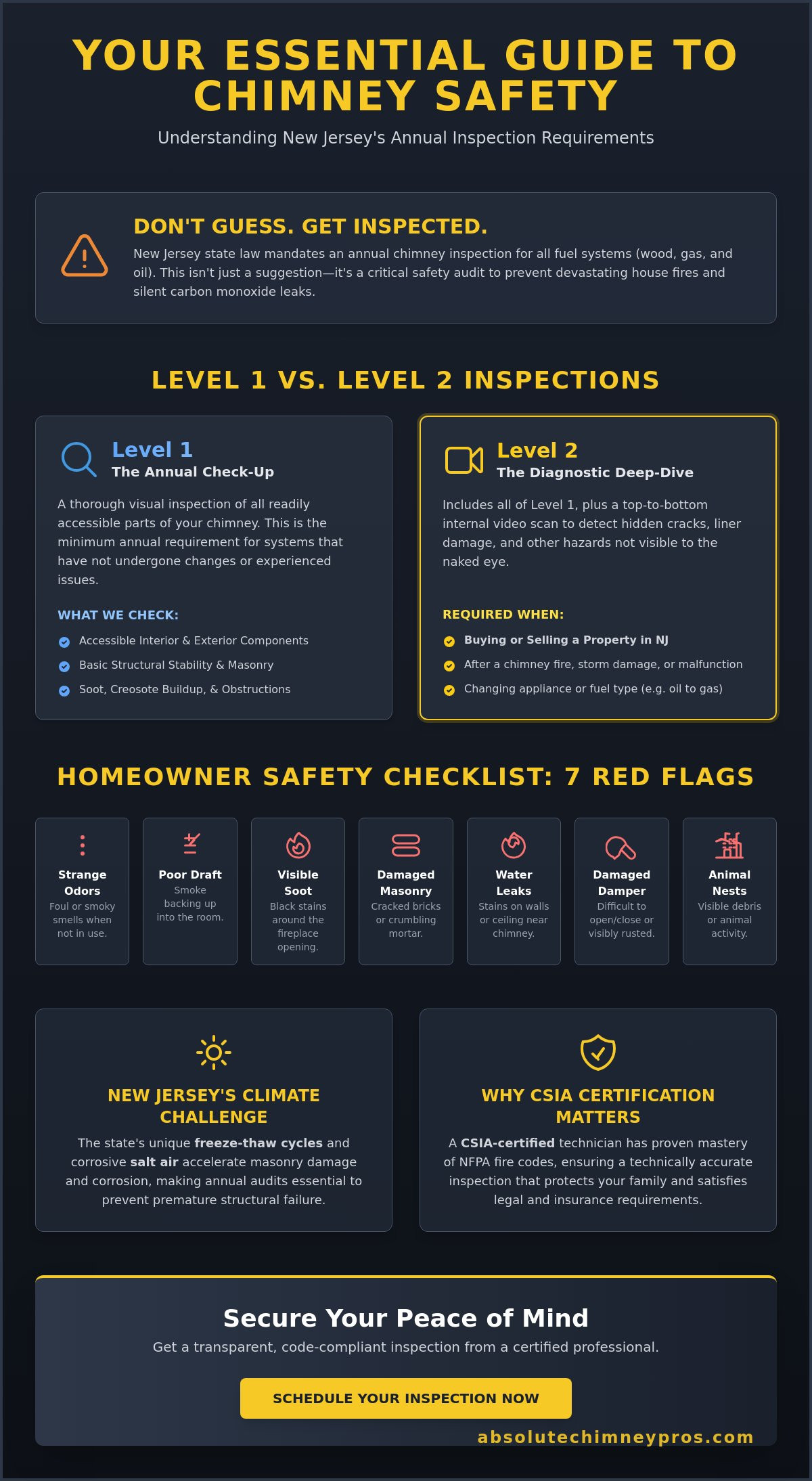
New Jersey residential codes follow the National Fire Protection Association (NFPA) 211 standards. These define three distinct levels of scrutiny. Level 1 is a basic visual check of accessible areas. Level 2 is more intensive. It includes a video scan of the chimney's interior and is required during property sales or after system malfunctions. Level 3 is the most invasive. It may involve removing parts of the building structure to investigate suspected hazards. A Level 1 inspection is the minimum annual requirement for systems that have not undergone any changes.
Why Certification Matters for NJ Homeowners
Don't trust your home to an uncertified "chimney sweep" with a ladder and a brush. Uncertified workers often lack proper liability insurance. They don't understand the complex physics of modern venting systems. CSIA certification ensures a technician has mastered the latest fire codes and safety protocols. It represents a commitment to ethical transparency and technical mastery. We prioritize your safety through disciplined expertise. Every visit includes a clear on-site estimate with no hidden fees. You get facts, not surprises. We act as your protective partner in home maintenance.
Level 1 vs. Level 2 Chimney Inspections: When to Use the Camera
Choosing between a Level 1 and Level 2 assessment isn't a matter of preference. It's a matter of safety protocols. A Level 1 chimney inspection New Jersey homeowners schedule for routine maintenance is a basic visual check. It covers readily accessible portions of the exterior and interior. If your heating system hasn't changed and you haven't experienced performance issues, this is your annual baseline. It's efficient. It's necessary. It ensures the status quo remains safe. We look for obvious obstructions and creosote buildup without opening walls or using specialized probes.
Level 2 is the technical deep dive. We deploy high-definition camera technology to inspect the flue's interior from top to bottom. This is non-negotiable when the "visible" isn't enough. These cameras reveal hidden flue tile cracks, detached liners, and internal blockages that a flashlight simply cannot reach. Following the NFPA 211 Chimney Inspection Standards, a Level 2 scan provides a definitive safety report. If you suspect a problem or haven't had a scan in years, you can schedule a comprehensive evaluation to see what’s happening behind the brickwork.
Real Estate and Property Transfer Requirements
New Jersey real estate transactions move fast. You don't want a structural flaw to kill a deal or cause a lawsuit later. Most NJ real estate laws and local codes effectively mandate a Level 2 inspection during a property sale. This protects the buyer from inheriting thousands in repair costs. It also satisfies mortgage lenders and insurance providers. A professional chimney inspection New Jersey buyers rely on is their best defense against post-closing disasters; you can also visit Lin Inspects to learn how professional property inspections provide additional precision for your real estate investments.
Post-Incident and System Change Audits
Events dictate the level of scrutiny. Did you experience a chimney fire? Did a heavy NJ storm drop a limb on your masonry? You need a Level 2 scan immediately. We also perform these audits when you change fuel types or appliances. Switching from oil to gas requires a flue that is properly sized and intact. Even "silent" events like the occasional New Jersey earthquake or a lightning strike can shift flue tiles. We find those shifts before they become fire hazards. Precision matters when your family's safety is on the line.
The Homeowner Safety Checklist: 7 Signs You Need an Inspection
Safety is not passive. It requires vigilance. You don't always need a ladder to identify a looming hazard. A ground-level check with a pair of binoculars can save your home. Scan the roofline for tilting. Look for debris in the firebox. If you spot trouble, act immediately. Ignoring these signals leads to total masonry failure and expensive structural repairs. A professional chimney inspection New Jersey residents book is the definitive solution to these early warnings. No guesswork. Just technical clarity.
Your chimney's health directly impacts your heating appliance. A clogged flue forces your furnace or fireplace to work harder. It wastes fuel. It risks your life. High-efficiency systems are particularly sensitive to venting obstructions. A minor blockage can trigger a system shutdown or, worse, a carbon monoxide leak. Don't wait for a crisis. Perform your own visual check today and document what you see.
Visual Indicators of Masonry Distress
Masonry is porous. Water is its primary enemy. Look for "spalling." This occurs when brick faces crumble or pop off entirely. It signals deep moisture saturation and freeze-thaw damage. Watch for efflorescence. These are white, salt-like stains on the brickwork. It isn't just a cosmetic issue. It's proof that water is moving through your chimney structure. Check the mortar joints. If they are soft, sandy, or missing, your structure is compromised. Finally, inspect the crown. A cracked chimney crown allows rain to bypass the flue and rot your interior walls from the inside out.
Sensory Warning Signs Inside the Home
Your senses are your first line of defense. Does your living room smell like a campfire when the fireplace is cold? That's the scent of creosote. It's a highly flammable byproduct of combustion. It needs professional removal. Watch the smoke. If it rolls back into the room instead of rising, you have a draft problem. This could be a physical blockage or a dangerous venting failure. Check your damper. If you see oily, black soot or flaky, honeycomb-like deposits, your system is overdue for a chimney inspection New Jersey experts provide. These deposits are fuel for a chimney fire.
Follow this checklist to assess your risk level:
- Spalling bricks: Crumbling masonry indicates structural rot.
- Efflorescence: White stains prove moisture is trapped inside the brick.
- Cracked crown: The "roof" of your chimney is leaking.
- Damaged mortar: Loose joints lead to eventual chimney collapse.
- Creosote odors: A "smoky" smell indicates a persistent fire hazard.
- Smoke backup: Poor drafting risks immediate carbon monoxide exposure.
- Soot buildup: Flaky deposits on the damper signal a dangerously clogged flue.
Why New Jersey Climate Demands Annual Chimney Audits
New Jersey weather is a relentless adversary for your home’s exterior. It isn't just about the cold. It’s about the moisture. Our state’s unique climate creates a cycle of destruction that targets porous masonry. Without a routine chimney inspection New Jersey homeowners risk structural failure before the first snowflake hits the ground. Vigilance is your best defense. We see the results of neglect every year. It isn't a matter of if the weather will impact your chimney, but when.
Coastal residents face an additional threat: salt air. If you live near the Jersey Shore, your metal chimney components are under constant attack. Salt accelerates oxidation. Stainless steel liners and chimney caps can corrode years ahead of their expected lifespan. Rust isn't just a cosmetic issue. It represents a breach in your home's fire barrier. Heavy Atlantic seasonal rains also test your chimney's waterproof integrity. A small leak in October becomes a flooded firebox by December. We identify these vulnerabilities before they require a total rebuild.
Freeze-Thaw Damage and Masonry
Moisture is the primary enemy of masonry. Bricks act like sponges. They soak up rain and humidity. During a typical New Jersey winter, this water freezes and thaws dozens of times. Each cycle widens microscopic fissures as the ice expands. Eventually, the brick face pops off in a process called spalling. A single season of water intrusion can compromise a flue. It leaves your home vulnerable to heat transfer and chimney fires. We don't just look for cracks. We identify the moisture entry points before they ruin your chimney crown or mortar joints. Precision matters here.
Carbon Monoxide Risks in NJ Winter Months
Heating equipment is a leading cause of home fires and carbon monoxide (CO) incidents. Many homeowners focus solely on wood-burning fireplaces. This is a dangerous oversight. Your gas furnace or boiler relies on a dedicated flue to vent toxic gases safely. If birds or raccoons nested in that flue during the spring, those gases have nowhere to go. They back up into your living space. A professional chimney inspection New Jersey residents trust includes a full audit of these utility flues. We ensure a proper draft even on the coldest Jersey nights. Don't gamble with a silent killer.
Protect your family today. You can book your professional safety audit to ensure your venting system is clear and functional for the upcoming season.
Certified Chimney Inspections with Absolute Chimney Pros
Absolute Chimney Pros delivers a chimney inspection New Jersey residents trust for technical precision and absolute honesty. We value your time. We offer same-week appointments across New Jersey and Philadelphia to ensure you aren't left waiting in an unsafe environment. Our approach is straightforward. We provide flat-fee inspection options and on-site estimates. You'll never encounter hidden fees or surprise charges. We're your protective partner in home maintenance. We handle everything from routine cleaning to complex structural masonry repair with disciplined expertise.
Transparency is our baseline. When we assess your home, we provide a clear report of our findings. We don't use vague language. We provide facts. This commitment to ethical transparency ensures you only pay for the services your home actually requires. Whether you need a simple safety check or a full chimney liner installation, we execute the task with punctuality and technical mastery. We take responsibility for the well-being of your environment.
Our Professional Inspection Process
Our CSIA-certified technicians operate with surgical accuracy. They arrive on time and follow a methodical protocol. We deploy advanced high-definition camera technology to perform a comprehensive diagnostic of your flue's interior. This technology allows us to see what others miss. We identify hairline fractures, detached liners, and structural shifts that are invisible from the hearth. After the inspection, you receive a detailed digital report. This document provides clear evidence of your system’s condition. It serves as your safety certification for insurance providers and real estate compliance. No guesswork. Just data.
Total Home Ventilation Safety
We look at the big picture. Fire prevention requires a whole-home strategy. That’s why we integrate chimney evaluations with dryer vent cleaning and air duct inspections. A clogged dryer vent is a ticking time bomb. Lint is just as flammable as creosote. Similarly, air ducts filled with debris compromise your indoor air quality and strain your HVAC system. By addressing these critical ventilation points together, we eliminate multiple fire hazards in a single visit. It’s about total peace of mind for your family. We blend traditional craftsmanship with modern efficiency to keep your home running safely.
Don't wait for a warning sign to appear. Take responsibility for your home's safety today. Schedule your same-week chimney inspection in New Jersey and ensure your family is protected for the season ahead.
Secure Your Home for the 2026 Winter Season
Safety isn't a suggestion. It's a structural requirement. New Jersey's relentless freeze-thaw cycles don't wait for your schedule. They compromise your masonry every single winter. You now understand the technical difference between a routine visual check and a high-definition camera scan. You know the red flags of spalling bricks and persistent creosote odors. Don't let these warnings go unaddressed. Securing a professional chimney inspection New Jersey residents trust is the final step in protecting your family from hidden hazards.
Absolute Chimney Pros provides technical mastery and ethical transparency. Our CSIA-certified technicians eliminate the guesswork with precise digital diagnostics. We value your time. That's why we offer same-week appointments across the region. We believe in honest, direct pricing. Our flat-fee inspection options ensure you receive a comprehensive safety report without hidden costs or surprise fees. You deserve the peace of mind that comes from disciplined professional oversight.
Take control of your home maintenance today. Book Your Flat-Fee Chimney Inspection Today. We look forward to acting as your protective partner in home safety.
Frequently Asked Questions
How much does a chimney inspection cost in New Jersey?
Costs vary based on the level of inspection and the complexity of your heating system. A Level 1 inspection is a standard visual check for routine maintenance, while a Level 2 audit involves internal camera diagnostics. Factors like chimney height and accessibility influence the final estimate. We provide transparent on-site estimates to ensure you understand the scope of work before any service begins.
Do I need a chimney inspection if I have a gas fireplace?
Yes, gas fireplaces require annual inspections to ensure proper venting and safety. Gas appliances produce carbon monoxide and significant moisture. Blockages from debris or animal nests can force these toxic gases back into your living space. A professional chimney inspection New Jersey homeowners schedule for gas systems also checks for pilot light functionality and proper draft. Safety is non-negotiable regardless of your fuel type.
What is the difference between a chimney sweep and an inspection?
An inspection is a technical safety audit of the structure, while a sweep is the physical cleaning process. The inspection identifies cracks, leaks, and structural hazards. The sweep removes flammable creosote and soot buildup. You shouldn't clean a chimney without inspecting it first. Cleaning can occasionally hide underlying damage that requires immediate repair. We perform both to ensure your system is clean and structurally sound.
How long does a professional chimney inspection take?
A standard inspection typically takes between 45 and 90 minutes. The duration depends on the level of inspection and the number of flues involved. Level 2 inspections using camera diagnostics take longer because we examine every inch of the interior liner. We work efficiently to respect your schedule. Our goal is a thorough assessment without unnecessary delays. You receive a clear report immediately following the visit.
Is a Level 2 chimney inspection required for selling a house in NJ?
Yes, most real estate transactions in New Jersey effectively require a Level 2 inspection. General home inspectors often lack the specialized tools to see inside the flue. A Level 2 scan provides a certified safety report that protects both buyers and sellers from hidden liabilities. It's a standard requirement for mortgage lenders and insurance companies during property transfers. Don't let a chimney issue stall your closing.
Can a chimney inspection detect carbon monoxide leaks?
Inspections identify the structural failures and blockages that cause carbon monoxide leaks. We don't just check for soot. We look for cracked liners and disconnected venting pipes that allow toxic gases to escape into your home. Ensuring a proper draft is a core component of every chimney inspection New Jersey experts perform. It's your best defense against this silent killer. We find the source of the risk before it becomes a tragedy.
What happens if my chimney fails the safety inspection?
If a hazard is identified, we provide a detailed report and a clear path to resolution. We mark the system as unsafe for use until repairs are completed. Our technicians explain the exact nature of the failure, whether it's a cracked crown or a deteriorated liner. We then provide a comprehensive estimate for the necessary chimney repair to restore your home’s safety. We prioritize honesty and transparency in every report.
How often should I have my chimney inspected in the NJ/PA area?
You should schedule an inspection at least once per year. New Jersey’s harsh freeze-thaw cycles can cause significant masonry damage in a single season. Annual checks are mandatory under state law for all fuel-burning systems. Regular audits allow us to catch minor moisture issues before they turn into expensive structural failures. Punctuality in maintenance prevents emergencies during the peak of winter.


