

The cost of whole-home air duct cleaning in Philadelphia depends on your home’s size, vent count, duct access, and the work included in the estimate. The package can also affect the scope: duct and dryer vent cleaning address separate systems, so compare exactly what each estimate covers.
It’s reasonable to want a clear figure before scheduling work. But a low starting price may not cover the whole system or account for the ducts’ condition and accessibility. Scope matters, as does whether the estimate covers ductwork alone or additional services.
This guide explains what affects the cost, what a thorough service may include, and how duct access influences the work. You’ll also learn how to compare duct and dryer vent cleaning packages without mistaking a limited offer for a whole-home service. The goal is to help you understand the job, the factors behind its price, and how to make an informed choice.
Key Takeaways
- Compare estimates by vent count, duct length, labor, and access conditions, not just the starting price.
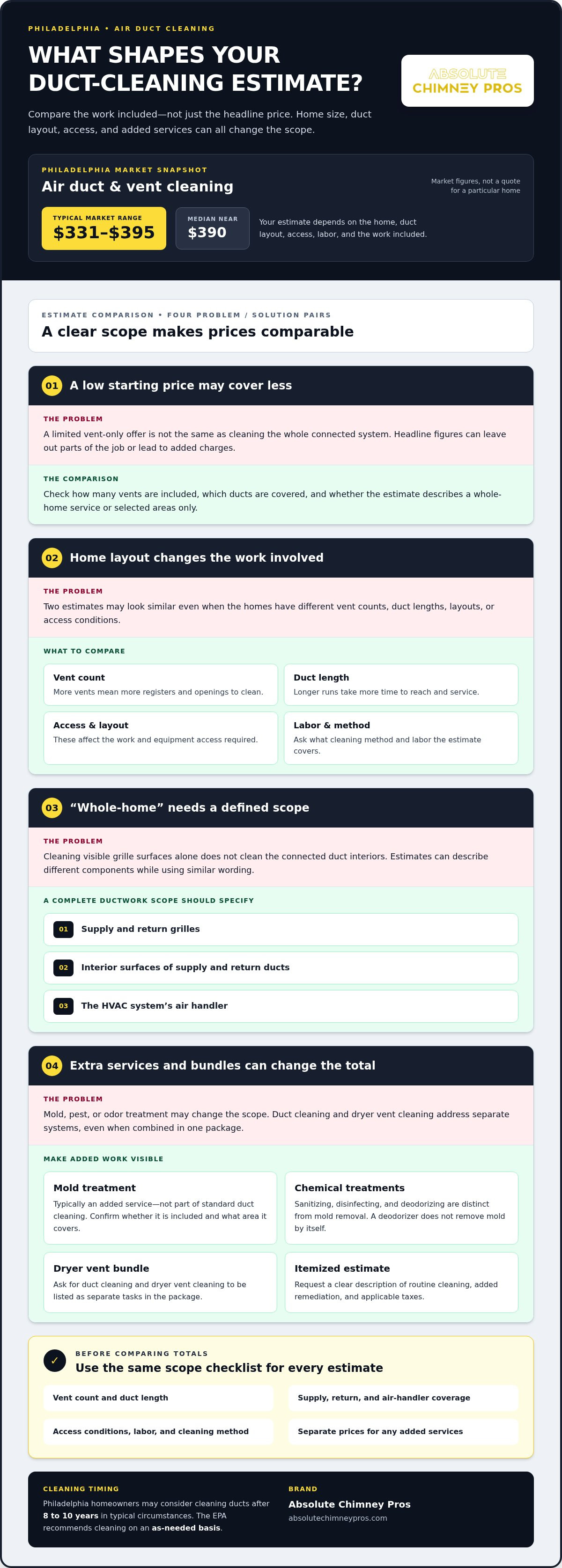
- Mold removal is typically an added service, so check whether it is part of the quoted scope.
- Look for a clear description of which system components the cleaning covers, including supply and return areas and the air handler.
- Existing openings provide access to duct interiors; household tools may reach only the final 10 feet of each duct.
- Consider bundling duct and dryer vent cleaning when both need attention, and remember the EPA recommends duct cleaning on an as-needed basis.
Do air duct cleaning services include mold cleaning?
Mold cleaning is typically an added service, not part of standard air duct cleaning. It may involve identifying the affected area, removing contamination, and addressing moisture conditions that support growth. An inspection can help distinguish visible mold from dust or staining. For example, discoloration near a supply vent alone does not establish that mold is present throughout the duct system.
Several job details shape the scope and labor. More vents mean more registers and openings to clean. Longer duct runs take more time to reach and service. Duct layout, access, and your home’s Philadelphia location can also affect the work involved. A written estimate should clarify whether it covers the whole system, selected ducts only, or additional mold treatment.
A complete ductwork cleaning should specify the components included. The work should cover supply and return grilles, the interior surfaces of supply and return ducts, and the HVAC system’s air handler. That scope matters: cleaning visible grille surfaces alone does not clean the connected duct interiors. Ask for an itemized description of each component before comparing estimates.
Equipment may include truck-mounted or portable vacuums. Chemicals may also be used to sanitize, disinfect, or deodorize ducts, but these steps are not the same as mold removal. A deodorizer addresses odors; it does not remove mold by itself. The estimate should name each treatment and explain which duct areas it covers.
In Philadelphia, air duct cleaning typically requires a permit; fees vary by project scope, and inspections are usually required before and after work. Tax treatment depends on the billing details, so a written estimate should separate the cleaning scope, added remediation, and any applicable taxes.
A reputable company should explain its technicians’ credentials, insurance, inspection steps, and equipment. Ask how the vacuum equipment captures loosened debris and how the team protects nearby rooms. Before work begins, the process should identify the supply and return sides, the air handler, and any proposed chemical treatment.
Low-cost offers may leave out parts of the system or lead to added charges. Improper tools or forceful brushing can damage flexible duct material, loosen connections, or push debris into the home. Compare the written scope, not just the headline offer. If mold treatment is needed, confirm that it is described separately from routine duct cleaning.
Mold treatment and chemical sanitizing, disinfecting, or deodorizing may be added to standard cleaning. Estimates should itemize each service separately, since the work involved affects the charges.
How Much Does it Cost to Clean an Air Duct in Philadelphia?
Philadelphia prices vary with the home, duct layout, and cleaning scope. Compare whole-home estimates by what they include, not by headline figures alone.
Philadelphia Price Ranges
On the market, air duct and vent cleaning typically ranges from $331 to $395, with a median near $390. Treat this as a market range, not a quote for a particular home. The estimate should identify the number of vents, the ductwork covered, and whether the job includes the entire system. A limited vent-only offer is not equivalent to whole-home cleaning.
Compare itemized scopes side by side. One estimate might cover supply ducts, returns, and vents, while another describes a narrower task. Check whether the listed work addresses your home’s layout and access. The amount due depends on the job and is provided after a quote request; vent count, duct length, access, labor, and added services shape the estimate.
Whole-Home Cleaning Costs
A whole-home estimate should describe the connected system, not price a single opening as the complete job. Duct length, vent count, equipment access, and cleaning method affect the work. Ask how the scope covers your home’s supply and return paths. This makes it easier to compare quotes that appear similar but include different components.
Package details can also change the total. For example, a quote that combines duct and dryer vent cleaning covers separate systems, so confirm that each task is listed. Mold, pest, or odor treatment may also change the scope. Each added service should be itemized clearly, not folded into an unexplained total.
When comparing companies in Philadelphia, review their stated credentials, insurance details, and recent reviews describing completed duct-cleaning work. Look for specific feedback about the estimate, the work performed, and whether the final scope matched the original description.
For typical circumstances, Philadelphia homeowners can consider cleaning ducts after 8 to 10 years. The U.S. Environmental Protection Agency recommends cleaning on an as-needed basis, while households with children, pets, or family members with respiratory issues may need more frequent attention.
Airflow concerns can help focus an inspection, but weak airflow from one register does not automatically mean the ducts are dirty. Check whether the issue affects one room or several, and note any visible dust or debris around vents. These observations can help clarify what the estimate should assess.
For a quote based on your home’s duct layout, explore air duct cleaning and compare the proposed scope with the factors above.
Potential indoor-air-quality and energy-efficiency benefits
Duct cleaning may remove accumulated dust and debris from inside the system. It does not guarantee better indoor air or lower energy use. The National Institutes of Health says evidence is insufficient to show that routine duct cleaning clearly benefits indoor air quality, health, or HVAC performance. Treat cleaning as targeted maintenance, not a guaranteed health or energy upgrade.
A typical home can collect more than 40 pounds of dirt, dust, and particles in one year. That material comes from household activity and other sources; its presence does not prove that ducts need cleaning. The U.S. Environmental Protection Agency recommends cleaning air ducts on an as-needed basis because benefits remain uncertain in most circumstances. Visible debris, contamination, or a specific system concern can help guide that decision.
Indoor air quality depends on more than duct interiors. A clogged filter, dusty return grille, or indoor source of particles can affect what circulates through a home. Start with a practical check: inspect the filter, supply vents, and return grilles. If dust quickly returns after you clean surfaces, note where it appears and when. Those observations can help distinguish a duct concern from routine household dust.
Cleaning may remove debris collected inside accessible duct sections, but it does not fix damaged ductwork, a malfunctioning air handler, or an airflow imbalance. For example, weak airflow from one register may point to a blocked vent or duct problem, while weak airflow throughout the home may involve the HVAC system. An inspection can help identify whether cleaning, adjustment, or repair addresses the cause.
Don’t assume cleaning will save energy. The National Institutes of Health reports insufficient evidence that routine cleaning clearly improves HVAC performance. You can track thermostat settings and airflow before and after service, but changes alone do not prove cleaning caused an improvement. A qualified HVAC assessment can distinguish duct buildup from equipment or system issues.
Some cases have shown higher indoor contaminant levels after duct cleaning than before. That makes method and scope important. Ask which parts of the system will be cleaned, how debris will be contained, and whether chemical products are planned. Cleaning should address an identified need without unnecessary treatments or disturbing more material than required.
The 90% of people who spend most of their time indoors may understandably focus on air quality, but routine duct cleaning is not a universal solution. Use an as-needed approach: document visible buildup or a specific concern, inspect related components, and address the source. If a duct is damaged, prioritize repair rather than treating cleaning as a substitute.
Accessing duct interiors
Cleaning can reach duct surfaces only through usable access points. Common examples include return grilles, duct end caps, and existing service openings. Their location affects how the duct interior can be reached. A return grille may provide access near the air handler, while an end cap can open a duct run farther away. The system layout determines which openings serve each section.
Before work begins, map the visible openings to the supply and return paths. Note which rooms connect to each register and where the return grilles are located. This helps distinguish a whole-system plan from cleaning only the easiest openings. For example, a technician can identify whether a hallway return and bedroom supplies connect to separate branches.
Existing openings are the starting point for accessing duct interiors. A professional can use them to reach sections without treating the visible grille as the whole duct. The access plan should account for bends, branches, and changes in direction. A straight run from a grille may be easier to reach than a branch behind a tight turn.
DIY tools have a limited reach. Household cleaning typically accesses only the last 10 feet of each duct. That may remove dust near a register, but it leaves more distant sections untouched. For example, a brush inserted through a bedroom vent cannot be assumed to clean the connected trunk line or other branches.
Access also depends on duct material and condition. Flexible duct can be vulnerable to rough handling, while rigid duct has a different construction. The cleaning method should suit the accessible section and material. If an opening shows loose connections, crushed flex duct, or visible damage, record its location before cleaning begins.
Use a clear sequence to understand coverage:
- Identify the return grilles, supply registers, end caps, and service openings.
- Trace which openings connect to the areas being cleaned.
- Note inaccessible branches or visible damage for inspection.
- Compare the planned access points with the system sections in the scope.
That sequence makes the work easier to evaluate. If the plan lists only room registers, ask how the connected duct interiors will be reached. If the system has several branches, the scope should show how each accessible section fits into the cleaning plan. A visible grille is one opening, not proof that every duct surface was reached.
Access limitations can affect how thoroughly a section can be addressed. A blocked service opening, concealed duct, or tight bend may restrict the route. Record those constraints alongside the affected room or branch. Clear notes help distinguish completed areas from those that still need inspection, repair, or another access approach.
Duct and dryer vent cleaning packages
A package can combine two separate systems: HVAC ductwork and the dryer exhaust path. That can simplify scheduling, but the work is not interchangeable. For example, cleaning return ducts does not remove lint from the dryer vent. Compare each task separately, even when one estimate groups them together.
Philadelphia homeowners should look for an itemized scope. The duct portion should identify which supply and return areas are covered. The dryer portion should specify the vent path being cleaned. A package that only says “whole-home cleaning” may not explain whether dryer vent cleaning is included. Clear descriptions help prevent gaps and surprise add-ons.
Extra charges may apply for dryer vent cleaning, sanitizing, or mold treatment, depending on the scope. Mold removal is typically an added expense, not part of standard duct cleaning. The price depends on the job and is provided after a quote request; vent count, duct length, access, labor, and added treatments affect the scope.
Sanitizing and deodorizing also differ from physical debris removal. Chemicals may be used to sanitize, disinfect, or deodorize ducts, but these treatments should be listed separately. For example, odor treatment does not mean mold was removed. The estimate should state the purpose of each product and which system areas receive it.
Use this package checklist before comparing totals:
- Confirm whether supply ducts, return ducts, grilles, and the air handler are included.
- Check whether the dryer vent is listed as a separate task.
- Identify any sanitizing, deodorizing, or mold treatment charges.
- Match each added charge to the area and work described.
Then consider whether both systems need attention. A dryer taking longer to dry clothes can prompt a vent inspection, while dust or debris inside ducts may point to a separate HVAC concern. If only one system needs cleaning, a combined package may include work you don’t need. Start with the actual issue, not the bundle label.
Ask for the final scope in writing, including exclusions and added treatments. If the dryer vent is damaged, cleaning alone may not address the problem; a repair may be needed. A clear estimate separates cleaning from repairs so you can see what each part of the job addresses.
For a clear scope covering ductwork or a separate dryer vent concern, request a cleaning quote and describe which system needs attention.
Absolute Chimney Pros: Chimney Sweep
Absolute Chimney Pros provides chimney sweeping for homeowners who need soot and buildup removed from a chimney. This is separate from air duct cleaning, but both services address different parts of home maintenance. Choose a chimney sweep when your fireplace or chimney needs cleaning; arrange a chimney inspection when you need its condition assessed.
If an inspection identifies a damaged liner or masonry issue, chimney liner installation or chimney repair may address that separate concern. Matching the service to the problem helps clarify what work is needed. Air duct questions call for a duct-specific assessment, not chimney work.
For chimney sweeping or an inspection, contact Absolute Chimney Pros to discuss the service that fits your home.
Plan Your Next Home Maintenance Step
Use your estimate as a starting point for a broader home maintenance plan. Keep notes on which systems need attention, what work was completed, and any issues that still need assessment. That record can help you schedule the right service instead of treating every concern as the same problem.
Your decision about the cost of whole-home air duct cleaning in Philadelphia is separate from chimney care. If your next task involves the fireplace, a chimney sweep or inspection can address that system. Chimney liner installation is a distinct service for a liner-related need.
For help with chimney maintenance, contact Absolute Chimney Pros. Take the next step that fits your home, and keep each system’s needs clear.
Frequently Asked Questions
How long does an average Philadelphia ductwork cleaning session take?
A regular-sized Philadelphia home may take about 2 to 4 hours, with at least two technicians. A typical air duct cleaning job can take three to eight hours, depending on the scope and home. Larger layouts and homes with pets may take longer. For planning, consider the number of rooms, system access, and whether the appointment covers additional work beyond duct cleaning.
What is the average cost of whole-home air duct cleaning in Philadelphia, PA?
There isn’t one flat figure for every Philadelphia home. The price depends on the job and is provided after a quote request. Vent count, duct length, system access, labor, and added treatments affect the estimate. To assess an offer, compare the stated work with the ducts and components your home needs cleaned, rather than relying on one headline amount.
What is the typical price range for air duct cleaning in Philadelphia homes by square footage?
Square footage alone doesn’t determine a dependable price range for Philadelphia homes. Two homes with the same floor area can have different vent counts, duct lengths, and layouts. Ask for an estimate based on the system itself, not just the home’s footprint. For instance, a compact home with many vents may require a different scope than one with fewer, shorter duct runs.
What factors affect the cost of air duct cleaning, such as number of vents, system size, or accessibility?
Vent count, duct length, system layout, labor, and access all influence the scope. A long branch or hard-to-reach duct can take more work than an open, direct run. Duct material also matters: rigid metal ducts typically cost less to clean than flex ducts, which require special equipment. Additional treatments, such as mold removal, are separate scope considerations.
How can I compare air duct cleaning quotes and identify what services are included?
Compare written scopes line by line. Check whether each quote covers supply and return ducts, grilles, vents, and the air handler. Then look for separately listed mold treatment, sanitizing, or deodorizing. For example, an estimate naming only vent openings may describe less work than one covering connected duct interiors. Matching components and add-ons makes differences between Philadelphia estimates easier to understand.
How long does whole-home air duct cleaning take, and what should homeowners do to prepare?
In Philadelphia, a regular-sized home’s cleaning may take about 2 to 4 hours with at least two technicians; a typical job may take three to eight hours. Before the appointment, clear access to supply registers, return grilles, and the HVAC unit. Move furniture or fragile items away from those areas, and note rooms with airflow concerns so they’re easy to point out.


