
What if the part of your chimney you can see isn’t the part your HOA is responsible for maintaining? HOA requirements for chimney maintenance NJ homeowners encounter depend on property boundaries and governing documents, not assumptions about who owns or pays for the work.
It’s easy to feel caught between an association’s instructions, a contractor’s recommendation, and your own reading of the rules. A wrong assumption can delay maintenance or lead to a dispute. A professional chimney inspection can document the system’s condition, but it can’t determine whether you or the association must arrange or pay for repairs.
This article explains which records to review, including the master deed, bylaws, and relevant property documents, and what to ask your board or property manager before scheduling service. You’ll also learn how applicable safety rules may affect maintenance, how to choose a chimney professional, and why clear inspection reports matter. With the right information, you can address chimney concerns without guessing about responsibility.
Key Takeaways
- HOA requirements for chimney maintenance NJ owners need to understand vary by governing documents, property boundaries, and applicable local requirements.
- Review the master deed, bylaws, and related property records to see how your community describes chimney ownership and maintenance.
- Whether a chimney serves one home, multiple units, or shared property can help frame the responsibility question, but examples aren’t universal rules.
- Before arranging non-emergency work, document what you’ve noticed and confirm access, approval, and responsibility with the board or property manager.
- A chimney professional can assess and document the system’s condition, helping owners or boards decide what to address next.
HOA Chimney Maintenance Requirements in New Jersey: What Sets the Rules?
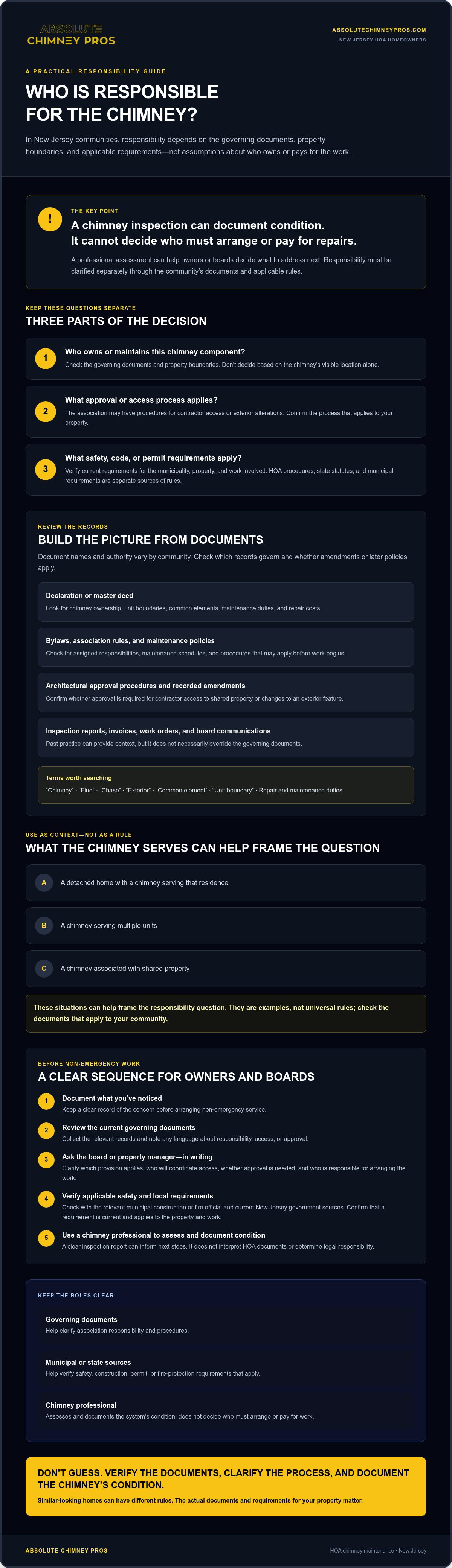
Short answer: Don’t assume one HOA rule applies to every New Jersey property. Responsibility depends on the community’s governing documents, who owns or uses the chimney components, and applicable state or local requirements. Professional maintenance recommendations can help assess safety, but they don’t decide who must arrange or pay for work.
A Homeowner association generally manages shared community interests under its governing framework. That general description isn’t a substitute for the documents and rules that apply to your property. HOA requirements for chimney maintenance NJ owners must follow can differ between communities, even when homes look similar.
What HOA documents may say about chimney care
Start with the declaration or master deed, bylaws, association rules, maintenance policies, and architectural approval procedures. Look for language about chimneys, flues, exterior structures, common elements, unit boundaries, repair costs, and approval before work begins. Document names and authority vary by community, so check which documents govern and whether amendments or later policies apply.
A policy might require approval before a contractor accesses shared property or alters an exterior feature. That doesn’t mean the same policy applies in every association. Read the actual documents and ask the board or property manager to identify the provision they’re relying on. Don’t base your decision on a neighbor’s experience or a sample HOA rule found online.
How New Jersey laws and local codes fit in
Association policies, state statutes, and municipal requirements are separate sources of rules. An HOA may set procedures for access or approval, while state or local requirements may address safety, construction, permits, or fire protection. One doesn’t automatically replace the others. A board’s preference isn’t proof of a legal requirement, and a contractor’s maintenance recommendation isn’t automatically an HOA rule or code mandate.
Local requirements can depend on the municipality and the work involved. Before treating a code or inspection standard as mandatory, verify that it’s current and applies to your property and situation. Check with the relevant municipal construction or fire official, and consult current New Jersey government sources for state-level requirements. A standard may be adopted into code, apply only in certain circumstances, or serve as professional guidance rather than law.
Keep the questions distinct: Who owns or maintains the chimney component? What approval process applies? What safety or code requirements apply to this work? Governing documents help clarify association responsibility, while a qualified chimney professional can document the system’s condition. An inspection report can inform next steps, but it can’t interpret HOA documents or determine legal responsibility.
How to Find Who Is Responsible for a Chimney in Your NJ Community
Don’t decide who pays based on the chimney’s location alone. Review the governing documents, identify which homes the system serves, then get the association’s interpretation in writing. This gives owners and boards a clearer basis for arranging maintenance and helps prevent assumptions from becoming disputes.
Which records should homeowners and boards review?
Use this sequence to build a reliable picture:
- Collect the current documents. Ask the property manager where to find the declaration or master deed, bylaws, rules, maintenance schedules, and recorded amendments. Confirm that you have current versions.
- Search for specific terms. Look for “chimney,” “flue,” “chase,” “exterior,” “common element,” “unit boundary,” and language assigning repair or maintenance duties. Note any approval steps required before work begins.
- Compare the written rules with the maintenance record. Review available inspection reports, repair invoices, work orders, and board communications. Past practice can provide context, but it doesn’t necessarily override the governing documents.
- Ask for clarification in writing. If the documents conflict or don’t clearly address the chimney, ask the board or property manager which provision applies, who will coordinate access, and whether approval is needed before you schedule service.
How ownership boundaries can affect maintenance duties
A detached home may have a chimney serving only that residence. In a condominium or attached-home community, a flue, chimney chase, or exterior masonry may serve multiple units or be classified as shared property. These are examples, not standard allocations. The community’s documents and the specific property arrangement determine what applies.
Check what the chimney actually serves. Does it vent one unit or connect to equipment in multiple homes? Do the documents treat the flue, exterior masonry, or chase differently from components inside a unit? A professional inspection can document the system’s condition and explain what was observed. It can’t determine whether the owner or association is responsible for the work or its cost.
For technical context on chimney inspection and maintenance, review the NFPA 211 standard. Use professional findings alongside the records, not as a replacement for checking ownership boundaries. That distinction is central to understanding HOA requirements for chimney maintenance NJ communities may set.
Once responsibility and access are clear, an inspection can create a useful record of chimney condition. Owners or boards considering a professional chimney inspection can use the findings to understand whether further work may be needed, then confirm approval and payment arrangements with the association.
Owner vs. HOA Chimney Maintenance: Compare Common NJ Scenarios
The same visible chimney can raise three separate questions: who arranges an inspection, who approves repairs, and who pays for the work? The answers may differ. Use the examples below as starting points for reviewing your community’s documents, not as legal conclusions or universal allocations.
| Property scenario | Possible arrangement to check | Questions to ask |
|---|---|---|
| Detached home with an individually served chimney | The owner may handle routine maintenance, while association rules may still cover exterior appearance, access, or alterations. | Do exterior repairs or changes need prior approval? Who arranges access to shared areas? |
| Attached homes with a shared chimney or flue | Shared use may require coordination among owners or association management. The documents may assign duties to one party or divide them by component. | Who schedules inspections? How are access, approvals, records, and costs handled? |
| Condominium chimney designated as a common element | The association may manage maintenance procedures, subject to the governing documents and applicable requirements. | Who authorizes repairs, notifies affected residents, retains inspection records, and allocates costs? |
Detached homes and individually served chimneys
If a chimney serves only one detached home, the documents may assign its maintenance to that homeowner. Don’t infer the rule from the building type, though. An HOA may regulate exterior appearance or require approval for work affecting shared property. Before arranging an exterior repair or alteration, confirm whether the association requires an application, contractor details, or access coordination.
Shared chimneys and condominium common elements
A chimney serving several units can make scheduling and access more complex. The documents may treat the flue, exterior masonry, and chase differently, so check each component rather than assuming the whole structure has one owner. If the chimney is identified as a common element, confirm the association’s process for arranging an inspection and authorizing repairs.
Ask the board or manager to clarify who contacts the contractor, who approves the scope of work, where reports will be kept, and how costs are allocated. The New Jersey chimney inspection checklist can help owners and boards prepare questions about an inspection. A professional assessment can document chimney condition, but it can’t determine HOA responsibility.
Ultimately, HOA requirements for chimney maintenance NJ owners encounter depend on governing documents, property-specific boundaries, and verified local requirements. Use the table to identify what to check, then get unclear responsibilities confirmed in writing before scheduling non-emergency work.
A Practical Checklist for HOA Chimney Inspections and Maintenance
A clear record helps owners and associations respond to chimney concerns without guessing at the cause or responsibility. Before scheduling non-emergency work, note what you observed, confirm who can authorize service, and keep paperwork from the inspection through any follow-up.
What to prepare before requesting a chimney inspection
Gather the information you already have. Avoid diagnosing the problem or attempting repairs yourself. Stick to observable details, such as a new stain near the chimney, visible masonry changes, or when the concern first appeared.
- Record the concern: Note its location, the date you noticed it, and any visible change over time. Take photos from a safe place if they help show the change.
- Collect relevant records: Find prior inspection reports, repair records, chimney or appliance details, and HOA instructions about contractor access or approvals.
- Confirm the process: Ask the board or property manager who is responsible for arranging an inspection, who can approve it, and what access arrangements are needed.
- Prepare for the visit: The NJ chimney sweep and safety preparation guide can help you plan what information to have ready.
Inspection frequency isn’t a one-size-fits-all matter. Confirm applicable state or local requirements for the property and work involved. Appliance use, chimney condition, and professional advice can also inform a maintenance schedule. Don’t treat an HOA policy or a contractor’s recommendation as a universal legal rule.
How to compare inspection findings and proposed work
Ask for written findings that separate what the professional observed from recommended follow-up. If a repair is proposed, request a clear explanation of its location, the condition being addressed, and why the work is recommended. This helps the owner or board review the issue and decide what needs further consideration.
Before authorizing repairs, confirm who has approval authority and whether the association requires additional consent. Keep the inspection report, estimate, written approval, invoice, and follow-up communications together in the owner’s or association’s records. If responsibility is disputed, those documents can clarify what was reported, approved, and completed.
Good records support safer, more organized decisions. They don’t settle ownership or payment questions by themselves. Review them alongside the governing documents and the applicable HOA requirements for chimney maintenance NJ residents need to follow.
If an inspection can help document your chimney’s condition, request a professional chimney inspection and share the written findings with the appropriate owner or association representative.
When an NJ HOA Should Bring in a Chimney Professional
A professional assessment can help an owner or board understand a chimney’s condition and document what needs attention. It doesn’t decide whether the HOA or homeowner is responsible. That question still depends on governing documents, ownership boundaries, and applicable requirements.
Consider arranging an evaluation when you notice visible damage, have no clear inspection history, or are planning chimney repairs. Don’t try to diagnose the cause from a stain, crack, or other visible change. A qualified professional can assess the system and explain observed conditions. Before scheduling, confirm who has authority to approve the visit and arrange access.
Questions to ask a chimney inspection provider
Clear expectations make an inspection more useful. Before booking, ask:
- Who will perform the work? Ask about the technician’s relevant credentials, licensing, and insurance, and confirm what documentation is available.
- What does the inspection include? Clarify which chimney components and accessible areas will be assessed, and whether you’ll receive written findings.
- How will findings be reported? Ask the provider to separate observed conditions from recommended follow-up and identify where each concern is located.
- What happens if repairs are recommended? Confirm whether the repair requires a separate estimate and whether the HOA or owner must approve it before work begins.
Keep the inspection report with the association or property records. Share it with the people responsible for reviewing the maintenance question. The report can inform next steps, but it can’t interpret HOA documents or establish who must pay.
A straightforward next step for New Jersey owners and boards
Absolute Chimney Pros provides chimney inspections, cleaning, and repairs in New Jersey, as well as service in Philadelphia, Pennsylvania. Work is performed by CSIA-certified, licensed, and insured technicians. A flat-fee inspection option is available. If an inspection identifies a need for further work, owners or boards can request an on-site estimate and then follow the community’s approval process.
For HOA requirements for chimney maintenance NJ residents are trying to understand, keep the roles clear: the professional documents chimney condition; the board and owner review responsibility under the governing documents. To arrange an assessment, request a chimney inspection. An inspection can provide useful information, but it won’t resolve an HOA responsibility or legal question.
Take the Next Step With Clear Records and a Professional Assessment
There’s no single rule that assigns chimney care to every New Jersey owner or HOA. Check the governing documents and property boundaries, then confirm who arranges inspections, approves repairs, and pays for work. Keep written findings and approvals with your records. That’s the practical way to apply HOA requirements for chimney maintenance NJ communities may set without confusing professional advice with a decision about responsibility.
If an inspection can help document your chimney’s condition, Absolute Chimney Pros serves homeowners in New Jersey and Philadelphia, Pennsylvania with chimney inspections, cleaning, and repairs. Technicians are CSIA-certified, licensed, and insured. A flat-fee inspection option and on-site estimates with no hidden fees are available. Confirm current appointment availability when you reach out.
Request a professional chimney inspection to get clear information about the chimney’s condition. You’ll be better prepared to discuss next steps with your board or property manager.
Frequently Asked Questions
Can an HOA require chimney maintenance in New Jersey?
An HOA may set chimney maintenance and approval procedures if its governing documents give it authority to do so. Check the declaration or master deed, bylaws, rules, and maintenance policies for language about chimneys, shared components, contractor access, and repairs. HOA requirements for chimney maintenance NJ owners face aren’t automatically the same as municipal code requirements. If the rules are unclear, ask the board to identify the relevant provision and verify code questions with the proper local authority.
Who is responsible for chimney maintenance in an NJ condominium?
Responsibility depends on the condominium’s governing documents and whether the chimney or a particular component is defined as a common element or part of a unit. A chimney serving several units may require association coordination, but that alone doesn’t establish who arranges or pays for every inspection or repair. Review the master deed, bylaws, and maintenance provisions. If they don’t clearly address the chimney, request the board or property manager’s written interpretation.
Does New Jersey require an annual chimney inspection for every home?
Don’t rely on an HOA rule or general advice to determine whether an annual inspection is legally required for your particular home. Verify current state and municipal requirements with authoritative New Jersey sources and the relevant local official. Inspection needs may also depend on the appliance, chimney condition, and professional advice. Keep written inspection records, and ask a qualified chimney professional what evaluation is appropriate for the system and circumstances.
Can an HOA choose the chimney contractor for a homeowner?
It depends on the governing documents, ownership boundaries, and the work involved. An association may have procedures for contractors working on common elements or accessing shared property, while work on an owner-maintained component may follow different rules. Before booking, ask whether the HOA requires approval, an approved contractor, or specific insurance documents. Request the applicable rule in writing, and confirm who is authorized to approve the scope and sign the service agreement.
Who pays for chimney repairs when a chimney serves multiple units?
The governing documents and property-specific facts determine how repair costs are handled. A shared chimney doesn’t automatically mean every owner pays an equal share, nor does shared use alone establish that the association pays. Check how the master deed or bylaws classify the chimney, flue, chase, and exterior masonry. Ask the board to explain the cost-allocation provision and keep the inspection report, repair estimate, approval, and invoice with the relevant records.
What should I do if my HOA and I disagree about chimney maintenance?
Gather the relevant declaration, bylaws, maintenance policies, inspection findings, and written communications. Ask the board or property manager to identify the provision behind its position and explain the decision in writing. Keep the discussion focused on the specific component, access, approval, and proposed work. If the disagreement continues, ask about the association’s dispute-resolution process. For a condominium, verify current New Jersey requirements for alternative dispute resolution with an authoritative source.
What should an HOA ask before hiring a chimney inspection company?
Ask who will perform the inspection and what credentials, licensing, and insurance apply. Confirm which components and accessible areas the inspection covers, and request written findings that separate observed conditions from recommended follow-up. If repairs are suggested, ask for their location, rationale, and a separate estimate. Before authorizing work, verify who can approve it under the governing documents. These steps help create a clear record without asking the professional to decide HOA responsibility.


