

The signs you need air duct cleaning can be easy to misread. Dust on a vent may look concerning, but it doesn’t prove the ductwork needs cleaning. Repeated debris blowing from vents, visible buildup inside an opening, or other recurring evidence is more useful to investigate.
It’s reasonable to wonder whether an unusual odor, uneven airflow, or dust buildup points to an HVAC problem. The EPA doesn’t recommend routine duct cleaning. It advises considering it when there’s substantial visible mold, a pest infestation, or heavy dust and debris in the ducts that’s being released into the home. One clue alone doesn’t confirm that cleaning is needed.
This guide covers seven observations to check, what each may suggest, and what it can’t confirm. You’ll also learn how to distinguish possible duct concerns from a dirty filter, equipment trouble, or moisture issue. When the cause isn’t clear, a camera-assisted air duct inspection can show visible conditions inside the ductwork before you decide on cleaning or repair.
Key Takeaways
- Use the seven clues to decide when a closer look at your ductwork may be worthwhile, without treating one symptom as a diagnosis.
- Track where dust, odors, or airflow changes appear and whether they recur. Patterns can help distinguish duct concerns from other HVAC issues.
- Check accessible grilles and the air filter before scheduling service, and note whether the concern affects one room or several.
- The signs you need air duct cleaning are observations to investigate, not proof that cleaning is necessary.
- A camera-assisted inspection can help show duct conditions and guide whether cleaning or repair is a sensible next step.
Signs You Need Air Duct Cleaning: Seven Clues to Look For
Changes around vents can raise fair questions, but a single clue rarely proves the ducts need cleaning. Treat the signs you need air duct cleaning as reasons to look more closely, not as a diagnosis. HVAC ducts carry air through the home, as described in Duct (HVAC), so note where and when a change appears before deciding what it means.
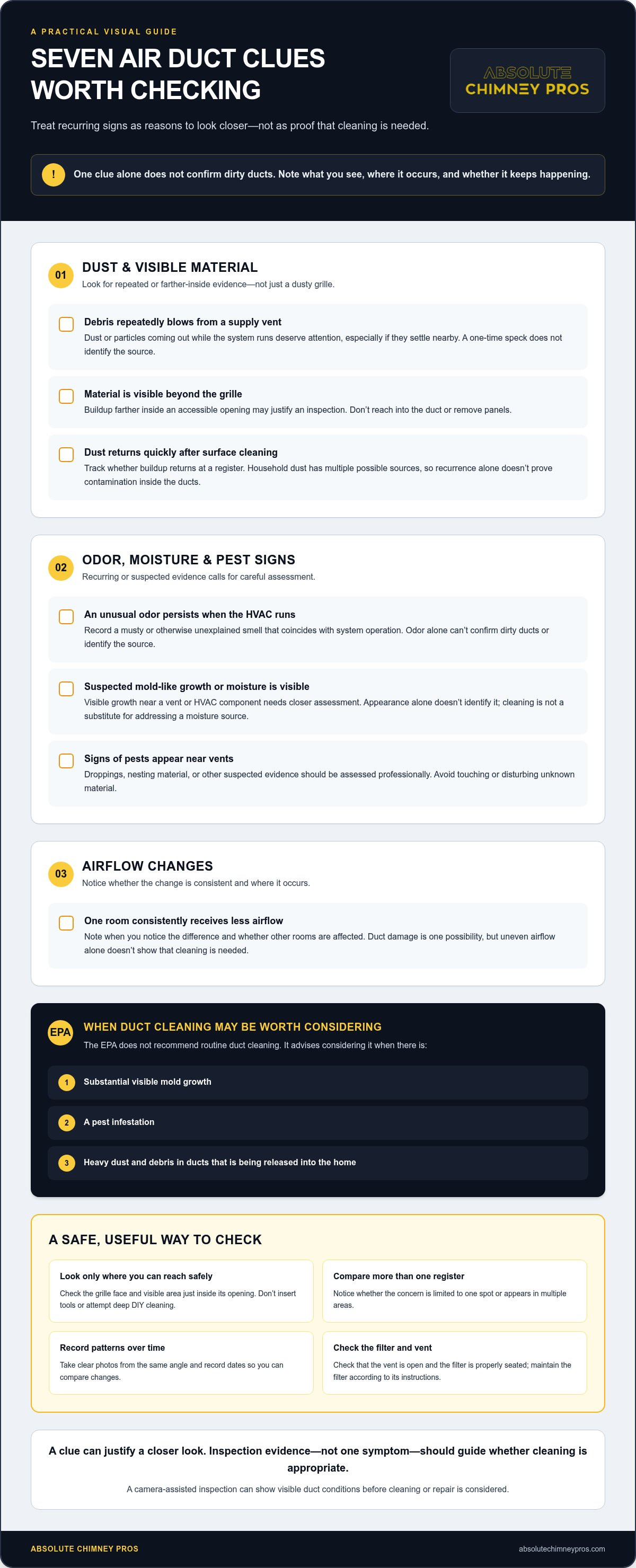
- Debris blows from a supply vent. Repeated dust or particles coming out while the system runs deserve attention, especially if they settle nearby. A one-time speck isn’t enough to identify the source.
- Material is visible beyond the grille. Buildup farther inside an accessible vent opening may justify an inspection. Don’t reach into the duct or remove panels to investigate.
- Dust returns quickly after surface cleaning. Recurring buildup at a register is a reason to track the pattern. Household dust has multiple possible sources, so recurrence alone doesn’t establish contamination inside the ductwork.
- An unusual odor persists when the HVAC runs. A musty or otherwise unexplained smell that appears with system operation is worth recording. Odor alone can’t confirm dirty ducts or identify the source.
- You notice suspected mold-like growth or moisture. Visible growth near a vent or HVAC component calls for closer assessment. Don’t assume its identity from appearance, and don’t treat duct cleaning as a substitute for addressing a moisture source.
- You find signs of pests near vents. Droppings, nesting material, or other suspected pest evidence should be assessed professionally. Avoid touching or disturbing unknown material.
- Airflow changes or seems uneven. If a room consistently receives less airflow than others, note when you notice it. Duct damage is one possibility, but this clue alone doesn’t show that cleaning is needed.
What can you see at supply vents and return grilles?
Look only at surfaces you can reach safely: the grille face and the visible area just inside its opening. Dust on the grille is different from material farther inside the system. Check more than one register, and note whether buildup returns after you clean the accessible surface. Take clear photographs from the same angle and record the dates so you can compare changes over time.
When do odors or debris deserve a closer look?
A persistent odor that coincides with HVAC operation, debris repeatedly discharged from a vent, or suspected pest material merits professional assessment. These are clues, not confirmation that cleaning is appropriate. Don’t disturb unknown material, insert tools into ductwork, or attempt a deep DIY cleaning. You could spread debris or leave the underlying issue unidentified.
An observable clue justifies a closer look; confirming whether cleaning is appropriate means assessing what’s inside the duct system.
What Air Duct Cleaning Signs Can, and Cannot, Tell You
A warning sign is an observation that may justify a closer assessment, not a diagnosis. Dust on a grille, a persistent odor, or a room that feels less comfortable can have several explanations. Even when something looks unusual, it doesn’t automatically mean the ductwork needs cleaning.
Dust can enter a home through everyday activity and collect on accessible surfaces. Filter condition and airflow through a room can also affect what you notice near a vent. A dusty grille, by itself, doesn’t show what’s inside concealed supply and return ducts or establish system-wide buildup or a health hazard.
Why dust near a vent does not prove the whole system is dirty
A grille is visible and easy to wipe; most duct interiors aren’t. Surface dust may accumulate on a vent without indicating that material coats the full duct system. Household dust has multiple possible sources, and a filter that needs attention may affect what appears around vents. Check and maintain the filter according to its instructions, but don’t treat grille dust as proof of duct contamination.
For context, the EPA Guidelines on Air Duct Cleaning don’t recommend cleaning on a routine schedule. The EPA advises considering it under specific conditions, including substantial visible mold growth, a pest infestation, or ducts heavily clogged with dust and debris that are being released into the home. That distinction helps put a visible clue in perspective.
What odors and comfort changes might indicate instead
A persistent smell when the HVAC system runs is worth describing, but odors can come from sources outside the ducts. Uneven airflow may relate to a blocked or closed vent, a filter, equipment, or duct condition. Cleaning isn’t a guaranteed fix for odors, allergies, uneven temperatures, or equipment faults. Don’t decide on the cause based on one symptom.
Make the observation more useful by recording where and when it occurs. Does the odor appear only while the system runs? Is one room affected, or do several rooms feel different? Does airflow change after you check that the vent is open and the filter is properly seated? These details help focus an assessment without turning guesswork into a diagnosis.
Inspection evidence, not a single symptom, should guide the decision to clean air ducts. A camera-assisted air duct inspection can help show visible duct conditions before cleaning is considered. If your observations keep recurring in New Jersey, an air duct inspection is a practical way to examine the concern and identify a sensible next step.
Air Duct Cleaning or Another HVAC Issue? Compare the Clues
Dust, odors, and uneven airflow can have more than one explanation. Compare what you observe with a sensible next check before assuming the ductwork needs cleaning. These clues can help narrow the question, but they can’t diagnose an HVAC problem on their own.
Observation: Dust on a grille
Possible explanations: Surface dust, general household dust, filter condition, or material in the ductwork.
Sensible next check: Clean the accessible grille surface and see whether dust returns. Check the homeowner-accessible filter according to the equipment instructions.
Observation: Dust or debris repeatedly coming from a vent
Possible explanations: Material near that register, an issue with the filter or system, or debris inside the ductwork.
Sensible next check: Note which vent is affected and when the debris appears. Repeated discharge warrants assessment rather than an assumption about its source.
Observation: Weak or uneven airflow
Possible explanations: A closed or obstructed vent, filter condition, equipment performance, or duct condition.
Sensible next check: Confirm the vent is open and check the filter as directed. If the difference recurs, arrange an HVAC assessment.
Observation: Persistent musty or unusual odor
Possible explanations: A moisture source, an equipment concern, or an odor elsewhere that becomes noticeable while the system runs.
Sensible next check: Record when and where the odor occurs. If it persists or returns, have the cause assessed.
Duct concerns versus a filter or equipment problem
Start with what you can safely access. Check the filter using the equipment’s instructions, and note whether it appears dirty, is seated properly, or needs replacement according to the manufacturer’s guidance. Don’t open equipment panels or attempt electrical or mechanical repairs. If airflow remains weak after basic checks, the HVAC system needs assessment. Don’t assume duct cleaning will fix it—in some cases, cooling performance issues call for dedicated unit servicing or new installations, as showcased by residential specialists at essexhomeairconditioning.co.uk.
Duct concerns versus moisture or an unexplained odor
A damp or musty smell that returns deserves investigation, particularly if you notice it in a specific area or only while the system runs. Odor alone doesn’t prove mold or show that ducts are contaminated. Don’t disturb suspected growth. A moisture source may need attention alongside any duct concern, or the problem could recur.
If the cause remains unclear, or the smell or airflow issue keeps returning, professional assessment is a sensible next step. The signs you need air duct cleaning are clues to evaluate, not a reason to skip diagnosis. An inspection can help determine whether visible duct conditions, another HVAC issue, or a separate moisture concern is the more relevant next step. When airflow or temperature issues stem from wider equipment faults rather than dirty ducts, comprehensive heating and cooling providers like Zee Jay Mechanical can help diagnose and resolve mechanical performance problems.
How to Check Air Duct Cleaning Signs Before You Schedule
A short record can help you decide whether an air duct inspection is worthwhile and distinguish a recurring pattern from a one-time change. Keep your checks non-invasive. Don’t remove duct covers or reach into the system.
A simple observation checklist for homeowners
Use the same basic process each time you notice a concern. Note whether the HVAC was running, where the issue appeared, and whether it came back. Those details are more useful than a general impression.
- Note the concern. Record the date, room, and what you noticed, such as visible dust, debris, an odor, or a change in airflow.
- Check accessible grilles. Look at the grille surface without removing covers or reaching inside. Take a clear photograph from a consistent angle.
- Track the pattern. Note whether one room or several are affected, whether the HVAC was running, and if the issue recurs.
- Add relevant context. Record recent renovations, water issues, or filter changes. Check the filter only as directed by the HVAC equipment manufacturer.
When an air duct inspection is a sensible next step
Consider an assessment if debris keeps appearing, visible buildup seems to extend beyond the grille, or an unexplained odor or airflow concern persists. A camera-assisted inspection can help show conditions inside accessible duct sections and inform whether cleaning, duct repair, or investigation of another cause may be appropriate.
Repeated observations make professional inspection a reasonable next step when the same concern returns or visible material appears to come from inside the system. That doesn’t mean cleaning is automatically required. Inspection findings can guide the decision.
If you’re comparing service value, review this air duct cleaning cost guide alongside what you’ve observed. Focus on what the service addresses rather than assuming every dusty grille calls for whole-home cleaning.
Make sure you’re tracking the right system. Lint or debris near a clothes dryer’s exhaust is a separate concern from HVAC ductwork. For that issue, see the professional dryer vent cleaning guide.
If recurring signs leave you unsure what’s inside the ductwork, schedule an air duct inspection. A camera-assisted inspection can help clarify visible conditions before you decide on cleaning or repair.
Air Duct Inspection and Cleaning in New Jersey: What Happens Next
Once you’ve recorded persistent concerns, the next step is to understand what’s visible in the ductwork. The signs you need air duct cleaning can guide an assessment, but they don’t determine the service by themselves. Absolute Chimney Pros provides camera-assisted air duct inspection, whole-home air duct cleaning, and air duct repair for New Jersey homeowners, including those in the Toms River area.
What a camera-assisted air duct inspection can show
A camera-assisted inspection helps examine accessible sections of ductwork instead of relying only on what can be seen at a grille. The visible conditions can help determine whether cleaning merits discussion or whether repair may be relevant, such as when ductwork appears damaged or disconnected.
An inspection has limits. A camera view of accessible sections doesn’t guarantee that every hidden area or possible HVAC issue will be identified. It provides information about what can be observed, making the next step more grounded than choosing a service based on a symptom alone.
Choosing a clear next step for your home
Share your observations with the on-site technician. Explain where the dust, odor, or airflow change appears, how often it returns, and whether it affects one room or several. Clear photographs and dates can make the concern easier to discuss. The appropriate next step depends on the observed duct conditions and what you’re trying to resolve.
Absolute Chimney Pros’ technicians are licensed, insured, and CSIA-certified. The company provides on-site estimates with no hidden fees, so you can review proposed work in relation to the inspection findings. If cleaning is appropriate, Absolute Chimney Pros offers whole-home air duct cleaning. If visible duct conditions point toward repair, air duct repair is also available. Neither an inspection nor cleaning should be treated as a promise to resolve unrelated equipment, moisture, or comfort issues.
Keep the decision evidence-led. A recurring clue can justify an inspection; what’s observed helps determine whether cleaning, repair, or another assessment is relevant. This keeps the focus on your home’s actual duct condition rather than assumptions based on dust or odor alone.
If concerns persist, schedule an air duct inspection with Absolute Chimney Pros to discuss what you’ve observed and examine accessible duct sections.
Make Your Next Step Evidence-Based
Not every change around a vent calls for cleaning. The useful question is whether a concern keeps returning and whether an inspection can clarify what’s happening. Keep your observations handy, but don’t feel you need to diagnose the cause yourself. A clear assessment helps you decide whether cleaning, repair, or another HVAC check is appropriate.
The signs you need air duct cleaning are prompts to investigate, not a reason to act on fear. If the issue persists, let visible duct conditions guide the conversation. That way, the next step can be based on your home’s actual conditions rather than assumptions.
Arrange an air duct inspection with Absolute Chimney Pros to take a closer, informed look at persistent concerns. With camera-assisted inspection and whole-home air duct cleaning and repair services for New Jersey homeowners, Absolute Chimney Pros can help you choose a sensible next step based on what’s observed.
Frequently Asked Questions
How often should air ducts be cleaned?
There isn’t a routine interval that applies to every home. Consider cleaning when there’s evidence such as substantial visible mold growth, pest infestation, or heavy duct debris being released indoors, rather than scheduling it automatically by the calendar. After renovations, for example, monitor for persistent debris and have the system assessed if it continues. The EPA’s guidance recommends an as-needed approach.
Can dusty air vents mean the air ducts need cleaning?
Dust on a vent can be one of the signs you need air duct cleaning, but it doesn’t confirm the duct interior is dirty. A thin layer on a grille may collect from normal household activity. Wipe the accessible surface, then observe whether dust returns or appears to blow from the vent. If debris repeatedly discharges while the system runs, document the pattern for an inspection.
Does air duct cleaning remove mold from a home?
No. Air duct cleaning addresses contaminants inside ductwork; it doesn’t remove mold throughout a home or correct the moisture that may be allowing growth. If you see suspected growth near an HVAC component, avoid touching it or trying to clean inside the system yourself. Have the affected area assessed, and make sure any moisture source is addressed. Otherwise, growth may return even after ductwork is cleaned.
Can air duct cleaning improve allergies?
Air duct cleaning isn’t a proven cure for allergies, and it can’t guarantee symptom relief. Allergens may come from sources elsewhere in the home, so cleaning ducts may not address what’s triggering symptoms. If you’re concerned about dust or other particles, note where they collect and review filter-care instructions for your HVAC equipment. Use inspection findings, not an expectation of medical improvement, to decide whether duct cleaning is appropriate.
How much does air duct cleaning cost in New Jersey?
There isn’t one price that fits every New Jersey home. The scope of work depends on the duct system and what an assessment shows. Absolute Chimney Pros provides on-site estimates with no hidden fees, so you can review the recommended work before deciding. Ask for a clear explanation of what the estimate covers, including whether it’s for inspection, cleaning, or repair. That makes it easier to compare the proposed service with your needs.
What should I do if I notice a persistent odor when the HVAC system runs?
Record which rooms are affected and whether the smell starts as soon as the system turns on or develops later. Note any recent water issues or changes around the HVAC equipment. Don’t use fragrance to mask the odor or disturb suspected growth. A persistent or recurring smell deserves professional assessment, since duct cleaning alone may not address a moisture source or equipment concern.


