
A visible chimney crack may be the first sign of a deeper problem. Loose masonry, a damaged liner, or water intrusion can point to repairs that aren’t obvious from the ground. Choosing licensed and insured chimney repair NJ means looking beyond credentials and asking whether the work is assessed carefully, explained clearly, and supported by appropriate protections.
It’s reasonable to want proof of qualifications, a diagnosis you can understand, and an estimate that leaves no guesswork. Licensing, insurance, and CSIA certification each serve a different purpose. This guide explains what they mean for chimney repairs in New Jersey, how inspection findings shape repair recommendations, and what to look for in a clear scope of work.
Absolute Chimney Pros serves New Jersey homeowners with CSIA-certified, licensed, and insured technicians. On-site estimates with no hidden fees and a flat-fee chimney inspection option help make the next step clearer. Use the guidance below to assess your chimney and understand the work it may need.
Key Takeaways
- Learn how licensing, insurance, and CSIA certification serve different purposes when evaluating chimney repair qualifications.
- See why a professional assessment should connect observed damage to a clearly defined repair scope instead of relying on assumptions.
- Compare licensed and insured chimney repair NJ options by reviewing credentials, inspection methods, estimate clarity, and communication.
- Record when leaks, loose masonry, damaged components, or fireplace performance changes begin to help inform an inspection.
- Find out how Absolute Chimney Pros’ chimney inspections, repairs, and on-site estimates can help you plan the next step.
Licensed and Insured Chimney Repair in NJ: What Homeowners Should Expect
Before authorizing chimney work, review the contractor’s qualifications and understand what the proposed repair is meant to address. A visible crack or leak can have more than one cause, so credentials matter most when they accompany a clear assessment and defined scope of work. If you want a basic refresher on what a chimney is, its flue and draft help explain why sound construction matters to safe operation.
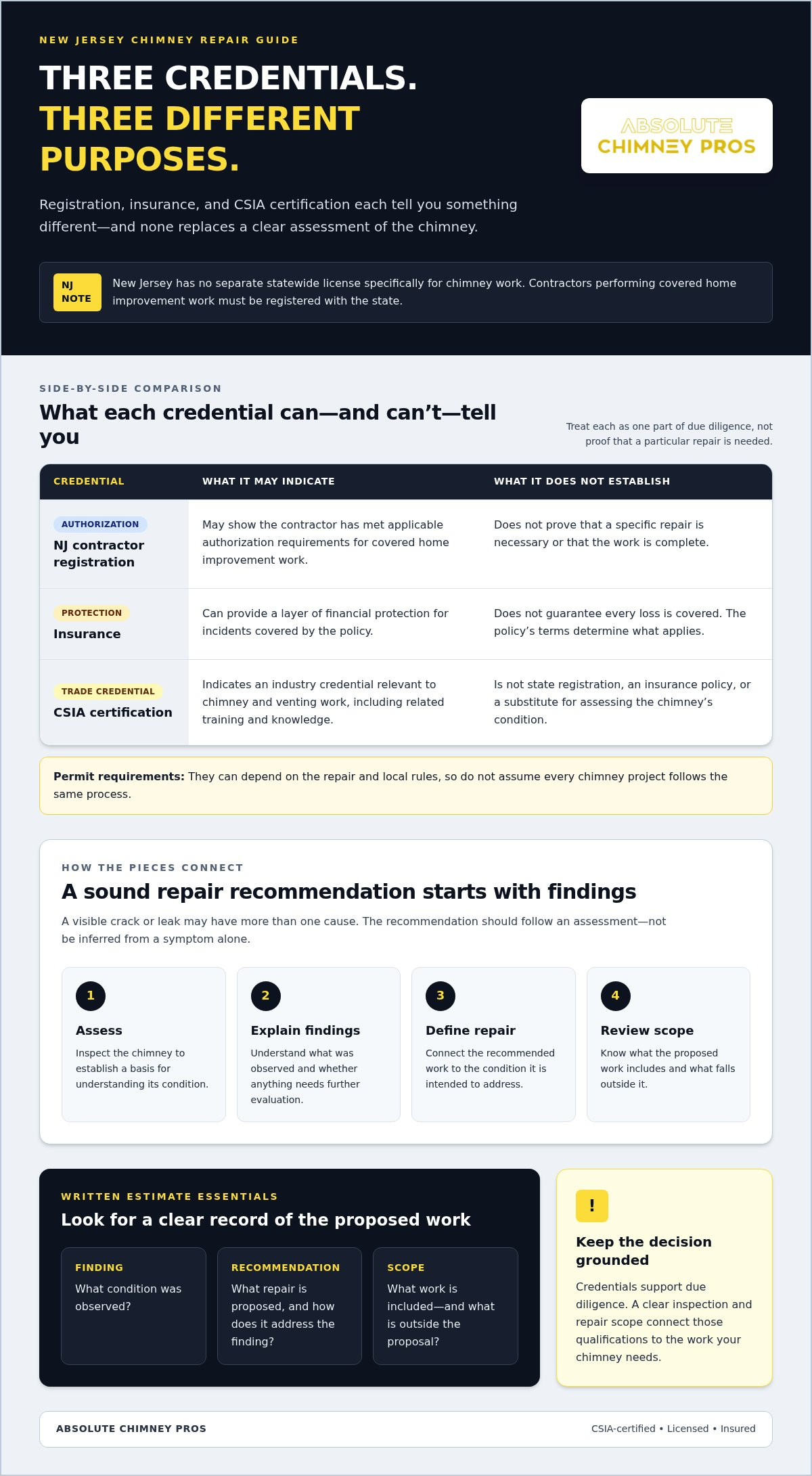
In New Jersey, there isn’t a separate statewide license specifically for chimney work. Contractors performing covered home improvement work must be registered as Home Improvement Contractors with the state. Permit requirements can depend on the repair and local rules, so don’t assume every chimney project follows the same process. Registration, insurance, and trade certification describe different things. The phrase “licensed and insured chimney repair NJ” is a useful starting point, not a complete assessment of a repair plan.
What credentials can indicate, and what they can’t
- License or registration: May show that a contractor has met applicable authorization requirements. It doesn’t prove a particular repair is necessary or complete.
- Insurance: Provides a layer of financial protection for covered incidents, subject to the policy’s terms. It doesn’t guarantee every loss will be covered.
- CSIA certification: Indicates a professional credential relevant to chimney and venting work. It isn’t the same as state registration or insurance.
What does licensed and insured mean for chimney repair?
“Licensed” can refer to authorization required for a type of work, while New Jersey’s home improvement framework uses contractor registration. These terms aren’t interchangeable. Insurance is separate: it can help address certain covered incidents, but the policy determines what applies. Together, these protections support due diligence. They don’t replace an inspection that explains the observed condition, recommended repair, and work included in the estimate.
How CSIA certification fits into a homeowner’s decision
CSIA certification is an industry credential for professionals working with chimneys and venting systems. It signals relevant training and knowledge, but it isn’t a state license, contractor registration, or insurance policy. Treat each credential as one part of the decision. Absolute Chimney Pros’ technicians are CSIA-certified, licensed, and insured. A professional inspection and clear repair scope connect those qualifications to the work your chimney needs.
How Credentials Connect to a Safer, Better-Defined Chimney Repair
Credentials matter most when they support a careful process. A professional should assess the chimney, explain the findings, define the recommended repair, and complete the work the homeowner approves. This helps connect the repair to the condition found, rather than just the first visible symptom.
A crack in the masonry may be easy to spot, but it doesn’t explain the cause or show whether other parts of the chimney need attention. An assessment helps distinguish what’s visible from what needs further investigation. The findings should be discussed in direct language, with practical next steps. For more guidance on what an inspection can involve, review this New Jersey chimney inspection safety checklist.
A credential is most useful when paired with a documented assessment and a clear repair scope.
From chimney inspection findings to a repair recommendation
An inspection gives the technician a basis for explaining the chimney’s condition and recommending work. You should be able to understand what was observed, why a repair is recommended, and whether any part of the concern needs additional evaluation. A qualified technician can connect the findings to the next step instead of inferring a full repair from one symptom. CSIA resources outline industry standards for chimney safety, adding context to the role of trained professionals.
That sequence matters for licensed and insured chimney repair NJ: a recommendation should follow the assessment, not precede it. If you’re unsure what an observation means, ask for a clear explanation before agreeing to work.
What a clear repair estimate should help you understand
A written estimate provides a useful record of the recommendation and where the proposed work begins and ends. It should connect the observed issue to the repair plan. Look for clarity on:
- The finding: What condition was observed?
- The recommendation: What repair is proposed, and how does it address that condition?
- The scope: What work is included, and what falls outside the proposal?
An on-site estimate relates recommendations to the chimney’s actual condition, rather than relying only on a brief description of a leak or damaged component. Absolute Chimney Pros provides on-site estimates with no hidden fees, helping homeowners understand the proposed work before it begins. Learn more about an on-site chimney assessment and repair estimate.
How to Compare Chimney Repair Providers in New Jersey
Compare credentials alongside the findings behind the recommendation and a clear record of the proposed work. Review those details side by side rather than choosing based on a headline claim or repair description alone. New Jersey’s rules can depend on the work and location. The state’s consumer alert discusses contractors being registered as a Home Improvement Contractor; local permit requirements may also vary. Don’t assume one municipality’s requirements apply everywhere.
Which credentials and documents are relevant to compare?
Keep each qualification distinct. Licensing or registration relates to applicable authorization. Proof of insurance relates to financial protection under the policy terms. Professional certification indicates relevant industry training. For New Jersey chimney work, compare these alongside the assessment and proposed repair. Absolute Chimney Pros’ technicians are licensed, insured, and CSIA-certified. No credential, on its own, guarantees a particular repair outcome.
| What to compare | What a clear process looks like |
|---|---|
| Credentials | Licensing or registration information, proof of insurance, and relevant professional certification are treated as separate items. |
| Assessment | The findings identify the observed condition and explain how it informs the repair recommendation. |
| Estimate and scope | The proposed work is documented, its boundaries are clear, and the estimate is understandable. |
| Communication | Questions receive direct answers, and recommendations are explained without relying on pressure or vague claims. |
How to compare repair recommendations without guesswork
Put the written proposals next to each other. Compare what each says was observed, what repair is recommended, and which work is included. A proposal that names a repair without connecting it to an inspection finding gives you less context for deciding. Clear communication helps you understand both the recommendation and its limits.
If water intrusion is part of the concern, a leak can have more than one possible source. This chimney leak diagnosis and repair guide explains why diagnosis matters before settling on a repair. For any chimney project, compare the findings and defined scope, not just the credentials or the estimate’s bottom line. That’s how licensed and insured chimney repair NJ becomes a more informed decision, with work tied to a documented condition.
What New Jersey Homeowners Can Do Before Scheduling Chimney Repair
A little preparation can make a chimney assessment more focused. Record what you’ve noticed, arrange a professional inspection, review the findings, then discuss the proposed repair scope. Your observations provide context, but they can’t confirm the cause or extent of a chimney problem. Leave roof access and structural work to trained professionals.
What information helps an on-site assessment?
Before the appointment, note when the concern first appeared and whether it has changed. Record leaks or water stains, loose masonry, damaged components, or changes in fireplace performance. If you have records of earlier chimney work, keep them nearby. Photos taken safely from the ground can also help show how a visible issue has changed. These details provide useful background, but they don’t replace a professional inspection.
Four steps to prepare for chimney repair
- Note symptoms. Write down what you’ve seen or noticed, including where water appears and when fireplace operation changed.
- Arrange an assessment. A professional inspection can help identify conditions that aren’t clear from a symptom alone.
- Review the findings. Ask for a plain-language explanation of the observations and how they inform the recommendation.
- Discuss the scope. Understand what work is proposed and what the estimate includes before authorizing repairs.
Don’t climb onto the roof to inspect a chimney, and don’t attempt structural repairs yourself. A ground-level view may not show the full condition, while roof access and masonry work involve hazards that require appropriate skills and equipment.
When should you schedule a chimney repair assessment?
Arrange professional attention when you notice leakage, loose masonry, damaged parts, or a change in fireplace performance. A symptom alone doesn’t establish its cause, so don’t assume one visible repair will address the whole problem. A timely assessment helps clarify what’s happening and what steps make sense. Absolute Chimney Pros offers same-week appointments.
If you’re preparing to move forward with licensed and insured chimney repair NJ, bring your notes and any relevant work history to the assessment. Read about scheduling a chimney inspection or repair assessment with Absolute Chimney Pros.
Schedule Licensed and Insured Chimney Repair with Absolute Chimney Pros
For New Jersey homeowners, start with a professional assessment that connects qualifications to clear, condition-based recommendations. Absolute Chimney Pros’ technicians are licensed, insured, and CSIA-certified. The company provides chimney inspections and repairs, with a flat-fee inspection option to help you begin with a defined assessment.
What to expect from the Absolute Chimney Pros process
The process begins with an on-site assessment of the chimney concern. The technician reviews the observed condition, explains what the findings indicate, and discusses recommended work in understandable terms. This matters because a leak, damaged masonry, or another visible symptom can have different causes. The repair scope should be guided by the chimney’s condition and your repair needs, not by assumptions.
Absolute Chimney Pros provides on-site estimates with no hidden fees. An estimate helps you understand the proposed work before it begins, including what the recommendation addresses. If anything in the scope is unclear, discuss it before authorizing the repair. A clear explanation gives you a practical basis for deciding how to proceed with licensed and insured chimney repair NJ.
Choose a clear next step for your New Jersey home
You can arrange a flat-fee chimney inspection or discuss a known repair concern. If you’ve noticed a leak, loose masonry, damaged components, or a change in fireplace performance, share what you observed and when it began. These details provide useful context for the assessment, while the inspection helps guide the recommendation.
Absolute Chimney Pros offers same-week appointments. Arrange a chimney inspection or repair assessment to review your chimney’s condition and understand the work it may need. Start with a clear assessment, then move forward with professional oversight and an understandable scope.
Move Forward with a Clear Chimney Repair Plan
Choosing licensed and insured chimney repair NJ is about more than checking credentials. Look for qualifications paired with an assessment that explains the observed condition, recommendations you can understand, and a defined repair scope. That gives you a clearer basis for deciding what work to authorize.
Absolute Chimney Pros’ technicians are licensed, insured, and CSIA-certified. Homeowners can choose a flat-fee chimney inspection, then review findings and recommendations informed by the chimney’s condition. On-site estimates with no hidden fees help make the proposed work easier to understand. Same-week appointments are available.
If you’ve noticed a leak, loose masonry, or a change in fireplace performance, arrange an assessment rather than guessing from a visible symptom. Schedule a chimney inspection or repair assessment with Absolute Chimney Pros to review the condition of your chimney and understand the next steps.
Frequently Asked Questions
Is chimney repair required to be performed by a licensed contractor in New Jersey?
Requirements can depend on the type of work and the municipality, so don’t assume one chimney-specific rule applies to every repair across New Jersey. Home improvement contractor registration and local permit requirements may be relevant to the project. Review the contractor’s applicable credentials and understand which local rules apply to the proposed work. Absolute Chimney Pros uses licensed, insured, CSIA-certified technicians for chimney work.
How can I verify that a chimney repair company is insured?
Request current proof of insurance and review the document for the business or insured party it identifies, the insurer, and policy dates. If you need clarification, contact the insurer using independently verified contact information. A document doesn’t guarantee that a particular incident or repair is covered; policy terms control. Insurance is separate from licensing and certification. Before authorizing licensed and insured chimney repair NJ, review the estimate and scope alongside credential information.
What does CSIA certification mean for chimney repair?
CSIA certification is a professional credential associated with chimney and venting expertise. It can support confidence in a technician’s relevant knowledge, but it isn’t a government-issued license, contractor registration, or insurance policy. Certification alone doesn’t establish which repair your chimney needs. Ask how the assessment findings connect to the proposed work. Absolute Chimney Pros’ technicians are CSIA-certified, licensed, and insured, and repair recommendations should still be based on the chimney’s observed condition.
Can a licensed and insured chimney professional inspect and repair my chimney?
Yes. A professional assessment can identify observed conditions and inform a repair recommendation, but the work needed depends on the chimney’s condition. A leak, for example, is a symptom, not a diagnosis, and may require evaluation before a repair plan is clear. An inspection doesn’t automatically mean repairs are necessary. Absolute Chimney Pros provides chimney inspections and repairs for homeowners in New Jersey and the Philadelphia, Pennsylvania area.
What happens if chimney damage is left unrepaired?
Some chimney damage may worsen with continued exposure to moisture, weather, or use, but the outcome depends on its cause and severity. A crack or leak alone can’t establish how extensive the problem is. If you notice visible deterioration, water entry, or a change in fireplace operation, arrange a professional assessment. Review the findings and repair options before deciding how to proceed, rather than relying on a remote diagnosis or assumption.
How do I compare chimney repair estimates in New Jersey?
Compare the documented findings, recommended work, scope boundaries, credentials, and clarity of each estimate. Similar repair labels don’t necessarily describe the same work, so look for the connection between the observed condition and the proposed repair. Don’t compare only the total amount. Absolute Chimney Pros provides on-site estimates with no hidden fees. The chimney’s assessed condition informs the repair recommendation and the work included in its scope.
How soon should I schedule chimney repair after noticing a leak or damaged masonry?
Arrange a professional assessment promptly so the condition can be evaluated before it changes further. Timing depends on what’s observed and its severity, so a symptom alone can’t determine the cause or urgency. Note when the leak or masonry damage first appeared and share any changes you’ve noticed. Absolute Chimney Pros offers same-week appointments. The assessment helps clarify the condition and appropriate next steps.


