

What if the soft fluff in your lint trap isn't just a laundry nuisance, but a highly combustible fuel source waiting for a single spark? Many homeowners overlook the hidden ductwork behind their machines. However, the concern goes beyond slow drying times. You need to know: can a clogged dryer vent cause a fire? The answer is a definitive yes. National fire statistics projected for 2026 continue to rank dryer fires as a leading cause of preventable household property damage. Lint is essentially tinder. When airflow is restricted, heat builds up to dangerous levels within the dryer cabinet.
You've likely noticed the warning signs already. Your towels take three cycles to dry. The laundry room feels like a sauna. You might even catch a faint, burning smell during a heavy load. These aren't just minor inconveniences; they are red flags for a restricted system. This guide breaks down how a simple blockage transforms into a high-combustion hazard. You'll learn to identify critical symptoms and discover how professional, camera-assisted inspections secure your NJ or Philadelphia home. Let's restore your peace of mind and protect your property today.
Key Takeaways
- Understand how restricted airflow forces internal temperatures to skyrocket, turning dry lint into a dangerous combustion source.
- Identify the specific mechanical failures that explain how a clogged dryer vent can cause a fire in your laundry room.
- Learn why your machine’s lint trap only catches 10% of debris and where the remaining fibers accumulate to create high-risk blockages.
- Recognize the five critical warning signs of a failing vent system, including excessive heat and recurring drying cycles.
- Discover the benefits of camera-assisted inspections to locate hidden damage and ensure your ventilation meets modern safety standards.
The Science of Ignition: How a Clogged Vent Becomes a Fire Hazard
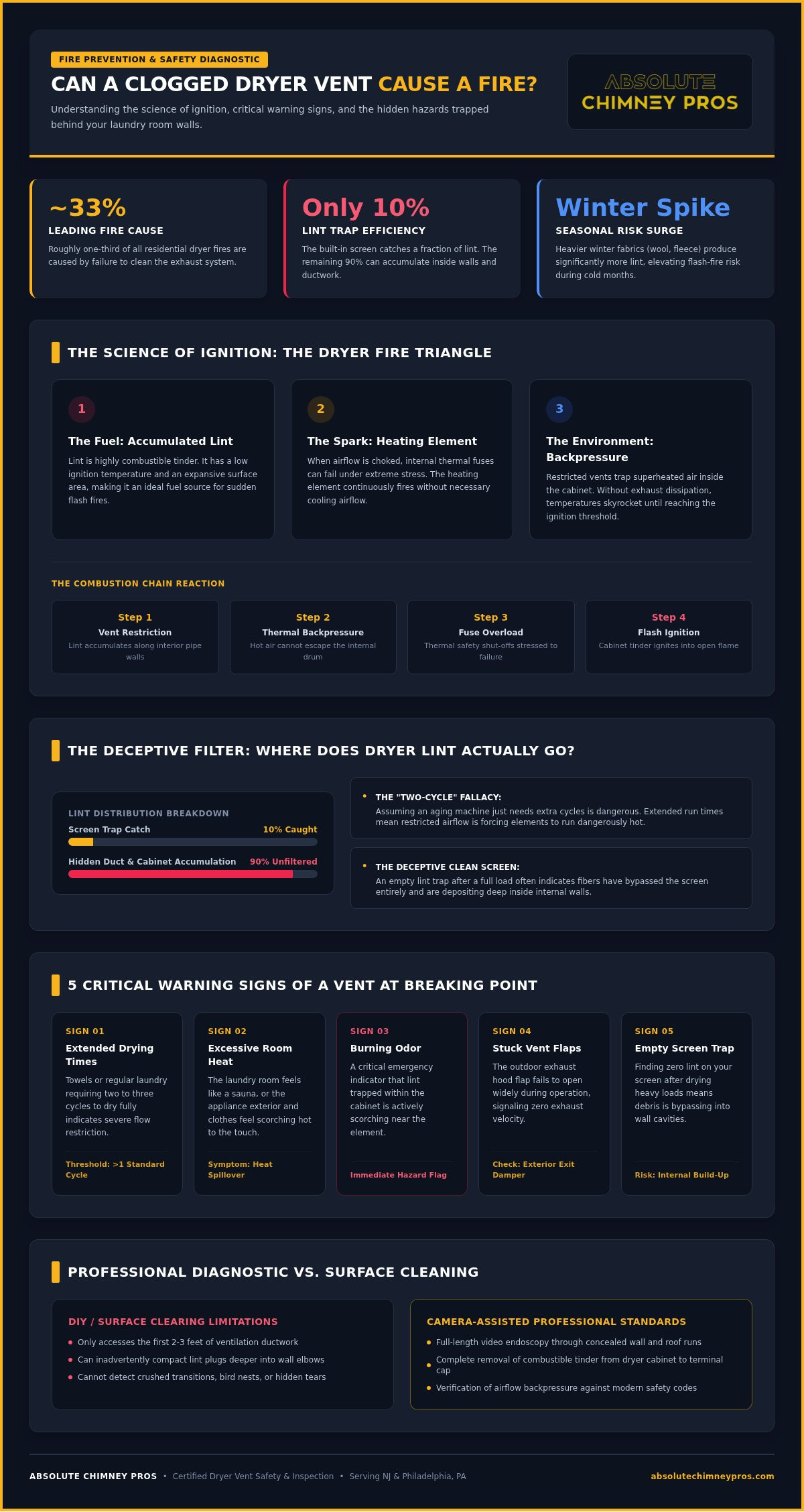
A dryer is a high-performance heat engine. It requires a clear path to exhaust moisture and heat. When lint builds up, this path narrows. This creates a dangerous chain reaction. You must understand the mechanics to answer the question: can a clogged dryer vent cause a fire? The answer lies in physics. Lint is not just dust. It is highly flammable tinder. It has a low ignition temperature and a high surface area. This makes it the perfect fuel for a flash fire. In the context of dryer ventilation, the Fire Triangle consists of accumulated lint as the fuel, the heating element as the ignition source, and the restricted exhaust path providing the necessary oxygen.
The Role of Airflow in Temperature Regulation
Dryers rely on a constant stream of air to regulate internal components. If the vent is blocked, the machine cannot breathe. This creates backpressure. The hot air stays trapped inside the drum and the internal cabinet. The heating element continues to fire, but the cooling effect of moving air is gone. Temperatures skyrocket. Modern dryers have thermal fuses designed to shut the unit down. However, these can fail under extreme stress. Eventually, the internal heat reaches the ignition point of the dry lint trapped in the crevices. This is the moment of ignition. Understanding how clothes dryers work and their fire risks is the first step toward home safety.
Critical Statistics: Dryer Fires by the Numbers
The data is sobering. National Fire Protection Association (NFPA) reports consistently show that dryers cause thousands of residential fires every year. Based on current trends, projections for 2026 suggest these incidents will remain a top threat to homeowners in NJ and the Philadelphia area. The leading cause is rarely a mechanical defect. Instead, it is the failure to clean the exhaust system. This accounts for roughly one-third of all dryer-related fires. It's a preventable disaster that starts with simple maintenance neglect.
There is also a distinct seasonal spike. Fires occur more frequently in cooler months. During winter, households dry heavier fabrics like wool, fleece, and heavy blankets. These materials produce significantly more lint than summer clothing. The machine works harder, the vent clogs faster, and the risk of a flash fire increases. Vigilance is required year-round. However, the danger is most acute when the weather turns cold and laundry loads become heavier. A clear vent is your primary defense against these statistics.
5 Critical Warning Signs Your Vent is Reaching a Breaking Point
Your dryer communicates its condition through performance. Ignoring these signals is a gamble. If you are asking yourself, can a clogged dryer vent cause a fire, you must look at these symptoms as the precursors to ignition. A machine that struggles to perform is a machine that is overheating.
- Extended Drying Times: Laundry should be dry in one standard cycle. If it takes two or three, your vent is likely restricted.
- Excessive Heat: The dryer exterior, the laundry room air, and the clothes themselves should not feel scorching hot.
- Burning Smells: This is a critical emergency. It indicates that lint is already scorching inside the cabinet.
- Stuck Vent Flaps: The exterior exit flap should open wide during operation. If it stays closed, the air is blocked.
- Deceptive Lint Traps: Finding no lint on your screen after a load often means the debris is trapped deep inside your walls instead.
The "Two-Cycle" Myth: Efficiency vs. Safety
A common mistake is assuming an aging machine simply needs more time. This is a dangerous assumption. If your laundry takes more than one cycle to dry completely, you have a ventilation crisis. Restricted airflow keeps moisture trapped. This forces the heating element to run longer and hotter than designed. This strain leads to mechanical failure or a thermal spark. Following a dryer vent cleaning NJ checklist ensures your system operates within safe parameters. Efficiency and safety are linked. A slow dryer is a dangerous dryer.
Physical Indicators Around the External Vent
Step outside while the machine is running. The exterior vent flap should be exhausting a strong stream of warm air. If it is stuck closed or only slightly vibrating, you have a major blockage. Check for bird nests, crushed ducting, or debris accumulation at the exit point. These physical barriers create immediate backpressure.
In many NJ homes with long duct runs, booster fans are used to move air over great distances. If these fans fail, lint settles quickly. It creates a solid wall of combustible material. A clean lint trap inside the house can be the most deceptive sign of all. If the screen is empty, the lint hasn't vanished. It is likely clogging your internal ductwork. If you notice these performance drops, a professional inspection can identify the exact location of the hazard before it becomes a fire.
Why Cleaning the Lint Trap is Only 10% of the Solution
Many homeowners believe that clearing the lint screen after every load ensures safety. This is a dangerous misconception. The screen is a primary filter, but it is not a complete barrier. It captures large clumps of fabric, but millions of microscopic fibers pass through the mesh during every cycle. These fibers enter the internal chassis and the exhaust ductwork. Relying solely on the lint trap is like cleaning the hearth of a fireplace while ignoring a soot-clogged chimney. The real hazard lives where you cannot see it.
The Journey of Lint Beyond the Screen
Once fine particles bypass the primary filter, they enter the transition duct. This is the flexible hose located directly behind your machine. From there, they travel into the main vent line. Moisture is the catalyst for trouble. Wet lint is heavy and sticky. It clings to the walls of the pipe, especially at elbows, bends, and long horizontal runs. Over several years, this creates a thick, furry lining. We frequently see 4-inch pipes restricted to a 1-inch opening. This severe restriction is exactly why the question persists: can a clogged dryer vent cause a fire? When airflow is this limited, the heat has nowhere to go but back into the dryer cabinet, where it meets a wall of combustible dust.
The Danger of Improper Duct Materials
The material of your vent determines how a fire behaves. Many older NJ homes still use flexible plastic or foil "accordion" connectors. These are significant fire hazards. Plastic vents are highly flammable. They melt quickly when exposed to high heat, allowing a fire to spread directly into the wall cavity. Their ribbed interior also creates air turbulence. This turbulence causes lint to settle much faster than it would on a smooth surface. It creates a cycle of rapid accumulation and increasing heat.
Rigid metal ductwork is the professional standard for a reason. It is non-combustible. It features a smooth interior that minimizes lint buildup and allows for maximum airflow. If a spark occurs, rigid metal helps contain the flame within the pipe rather than feeding it. If you find white plastic or thin foil venting in your laundry room, you are operating with an outdated and high-risk system. Replacing these materials with certified rigid metal is a critical step in securing your home from a high-combustion disaster. It's a simple fix that provides long-term peace of mind.
Professional Inspection vs. DIY: Ensuring a Clear Path to Safety
DIY maintenance often provides a false sense of security. A standard household vacuum lacks the reach and static pressure to clean the 15 to 25 feet of ductwork hidden behind your walls. You might clear the visible lint, but the core hazard remains untouched. You need to know: can a clogged dryer vent cause a fire even after a DIY cleaning? The answer is a definitive yes. In fact, many home attempts actually increase the risk. Without professional equipment, you often push loose lint deeper into the system, creating a dense plug at the first elbow or bend.
Local housing in NJ and Philadelphia frequently features complex laundry configurations. Vents travel through crawlspaces, up through second-story walls, or across long basement runs. These extended paths are primary sites for heavy accumulation. A standard shop vac lacks the power to pull heavy, moist debris through these distances. It leaves the thickest clogs in the center of the run where internal heat buildup is most intense.
The Limitations of DIY Cleaning Kits
Consumer-grade brush kits are frequently a liability. These flexible rods can snap or become detached inside the wall. If a brush head gets stuck in a 90-degree elbow, you've created a permanent, high-combustion blockage. If your home still uses outdated foil or plastic connectors, these aggressive brushes will puncture the material. This vents hot, moist air and lint directly into your floor joists or attic. A chimney inspection New Jersey often reveals how secondary ventilation systems are neglected compared to the main fireplace, despite carrying similar fire risks.
What a Professional CSIA-Certified Tech Does Differently
CSIA-certified technicians bring precision and specialized equipment to your laundry room. We use high-powered reverse-air tools and mechanical brushes designed for extraction, not just movement. Our process includes camera-assisted inspections to see exactly what is happening behind the drywall. We identify disconnected joints, crushed pipes, and animal intrusions that a DIY kit would bypass. We don't guess about your safety; we measure it. By testing the Cubic Feet per Minute (CFM) at the exterior exit, we verify that your machine is exhausting at factory specifications. This thoroughness provides the peace of mind that a vacuum attachment never can. Protect your property with a professional dryer vent cleaning and inspection to ensure a truly clear path to safety.
Absolute Chimney Pros: Certified Dryer Vent Safety in NJ & PA
NJ and Philadelphia property owners face specific ventilation challenges. Many local homes feature long, winding duct runs that pass through multiple floors, basements, or crawlspaces. These configurations are prone to heavy lint accumulation. We understand these local systems. Our technicians are CSIA-certified experts. They don't just clean; they ensure your home meets current safety codes. If you've wondered, can a clogged dryer vent cause a fire, our team provides the definitive answer through rigorous inspection. We treat every vent as a critical exhaust system. We apply the same precision we use for complex chimney liners. This is not a secondary service. It is a core safety mission.
Transparency is our foundation. We offer flat-fee inspection options for NJ and PA residents. There are no hidden fees or surprise costs. We provide an exact report of our findings. If we find structural issues like disconnected joints, crushed pipes, or bird nests, we provide expert dryer vent repair. We resolve hazards immediately. You receive a clear, honest report on the state of your laundry room's safety. Our goal is simple. We want to eliminate the risk of a high-combustion event before it starts. We act as your vigilant protector. We answer the question of can a clogged dryer vent cause a fire by removing every potential spark point in your system.
Our Multi-Point Safety Inspection Process
We leave nothing to chance. Our process begins with a comprehensive visual assessment. We use camera-assisted inspections to scan the entire interior of the duct. This reveals hidden blockages and damage that standard consumer tools miss. We find the disconnected joints that leak hot, moist air into your attic or floor joists. We clean from both the dryer side and the exterior exit. This dual-access method ensures every inch of the run is clear of combustible material. Finally, we perform precision airflow testing. We verify your machine exhausts at the correct velocity. This confirms the fire risk is neutralized. We provide technical mastery on every job.
Scheduling Your Annual Safety Check
Fire prevention requires consistency. An annual inspection is the industry standard for safety. As we head into 2026, don't leave your property's safety to guesswork. We offer same-week appointments for NJ and Philadelphia homeowners. Our schedule fills quickly during the peak laundry seasons of autumn and winter. Secure your peace of mind now. Our no-nonsense approach values your time and your safety. We arrive on time. We execute the task. We leave your home secure. Schedule your professional dryer vent inspection today.
Secure Your Home Against Hidden Laundry Hazards
A dryer fire is a preventable disaster. You now understand the dangerous mechanics: restricted airflow creates backpressure, internal heat reaches extreme levels, and accumulated lint provides the perfect fuel. The question of can a clogged dryer vent cause a fire is answered by the thousands of residential incidents reported every year. Your machine's lint screen is only the first line of defense. Real safety requires a clear path through the entire exhaust system. Ignoring the warning signs puts your property at unnecessary risk.
Don't wait for a burning smell or multiple drying cycles to alert you to a blockage. Our CSIA-certified technicians are the premier NJ and Philadelphia local experts in ventilation safety. We utilize camera-assisted accuracy to ensure every joint is secure and every inch of ductwork is clear of combustible debris. We eliminate the guesswork from your home maintenance. Take the proactive step today to protect your property and your family. Book Your Certified Dryer Vent Safety Inspection. Peace of mind starts with professional oversight.
Frequently Asked Questions
Can a clogged dryer vent really cause a house fire?
Yes, it is a significant risk. Lint is essentially tinder and ignites at relatively low temperatures. When airflow is restricted, the internal heat of the machine rises until it reaches the ignition point of the accumulated debris. This is exactly how a clogged dryer vent can cause a fire in your home. National fire statistics consistently rank failure to clean dryer vents as a leading cause of preventable residential property damage.
How do I know if my dryer vent is clogged?
The most common sign is laundry taking multiple cycles to dry completely. You might also notice that the top of the dryer feels hot to the touch or that your laundry room is unusually humid. Check the exterior vent exit while the machine is running. If the flap is not opening or there is no strong stream of warm air, you have a dangerous blockage that requires immediate professional attention.
Is it safe to use my dryer if I smell something burning?
No, you must stop using the machine immediately. A burning smell indicates that lint is already scorching or that a component is overheating due to restricted airflow. Unplug the unit and do not restart it until a CSIA certified technician has inspected the entire vent run. Continuing to operate the dryer under these conditions is an immediate fire hazard for your New Jersey or Philadelphia property. Safety must come first.
Will a clogged vent make my electric bill higher?
Yes, a restricted vent significantly increases your energy consumption. When air cannot escape, the dryer must run for longer durations to remove moisture from the fabric. This often doubles or triples the energy required for a single load of laundry. Beyond the higher utility costs, this extra run time puts unnecessary strain on the heating element and motor. This leads to premature mechanical failure and expensive appliance repairs that could have been avoided; for those in the Ottawa region, you can discover Honest Guys Appliance Repair to address these technical issues before they escalate.
Most household vacuums lack the reach and static pressure to clean a full duct run. While you can clear the transition hose, you cannot reach the deep clogs hidden inside your walls. DIY kits often push lint further into the pipe, creating a dense plug at the first elbow. Professionals use high powered reverse air tools and camera assisted inspections to ensure the entire path is clear and structural joints are secure.
How often should a dryer vent be professionally cleaned?
Annual cleaning is the industry standard for fire prevention. If you have a large family or dry heavy items frequently, you might require service every six months. Homes in the NJ and Philadelphia area with long, complex duct runs are especially prone to rapid buildup. Regular maintenance ensures your system operates at peak efficiency. It also provides a documented safety record for your home, which is essential for long term property protection.
What is the most dangerous type of dryer vent hose?
Flexible plastic and thin foil accordion style hoses are the most hazardous. These materials are highly flammable and melt quickly if a spark occurs. Their ribbed interior also traps lint much faster than smooth surfaces. Rigid metal ductwork is the only professional recommendation for fire safety. It contains flames if an ignition occurs and allows for maximum airflow. We recommend replacing all plastic or foil connectors during your next safety inspection.
Does home insurance cover dryer fires caused by poor maintenance?
Insurance coverage varies, but many providers can deny a claim if they determine the fire resulted from gross negligence or lack of maintenance. An adjuster will look for evidence that the vent was neglected. Having a professional report from a CSIA certified technician provides proof that you took reasonable steps to maintain your home. It is better to invest in a flat fee inspection than to risk a denied claim after a total loss.


