

Slapping fresh mortar over crumbling brick will not save a structurally failing chimney stack. Surface repairs inevitably fail when trapped moisture expands inside the core, pushing loosened bricks outward. If you have spotted fragments on your roof or lawn, you are likely asking the critical question: does your chimney require routine maintenance, or is it time for a structural chimney rebuild NJ building codes require? Watching masonry deteriorate triggers valid fears of sudden collapse, severe roof damage, and complicated municipal permit hurdles.
You don't have to guess about your family's safety. This guide gives you the tools to diagnose structural damage accurately, determine whether you need a partial roofline rebuild or total reconstruction, and verify local New Jersey code compliance. We will walk you through the entire restoration process so you can hire certified professionals with complete confidence. Here is how to stop water intrusion at the source and protect your home from hazardous masonry failure.
Key Takeaways
- Spot the hidden warning signs of flue degradation and masonry failure before loose bricks threaten your property.
- Differentiate between surface repointing, partial roofline rebuilds, and total reconstruction to avoid wasting money on ineffective repairs.
- Understand how New Jersey freeze-thaw cycles exert severe hydraulic pressure on vulnerable mortar joints.
- Follow the exact engineering and municipal permitting standards required for a safe, code-compliant chimney rebuild NJ contractors must execute.
- Safeguard your masonry investment with certified Level 2 diagnostic scans and breathable weatherproofing barriers.
Critical Warning Signs: When Does a Chimney Require Rebuilding?
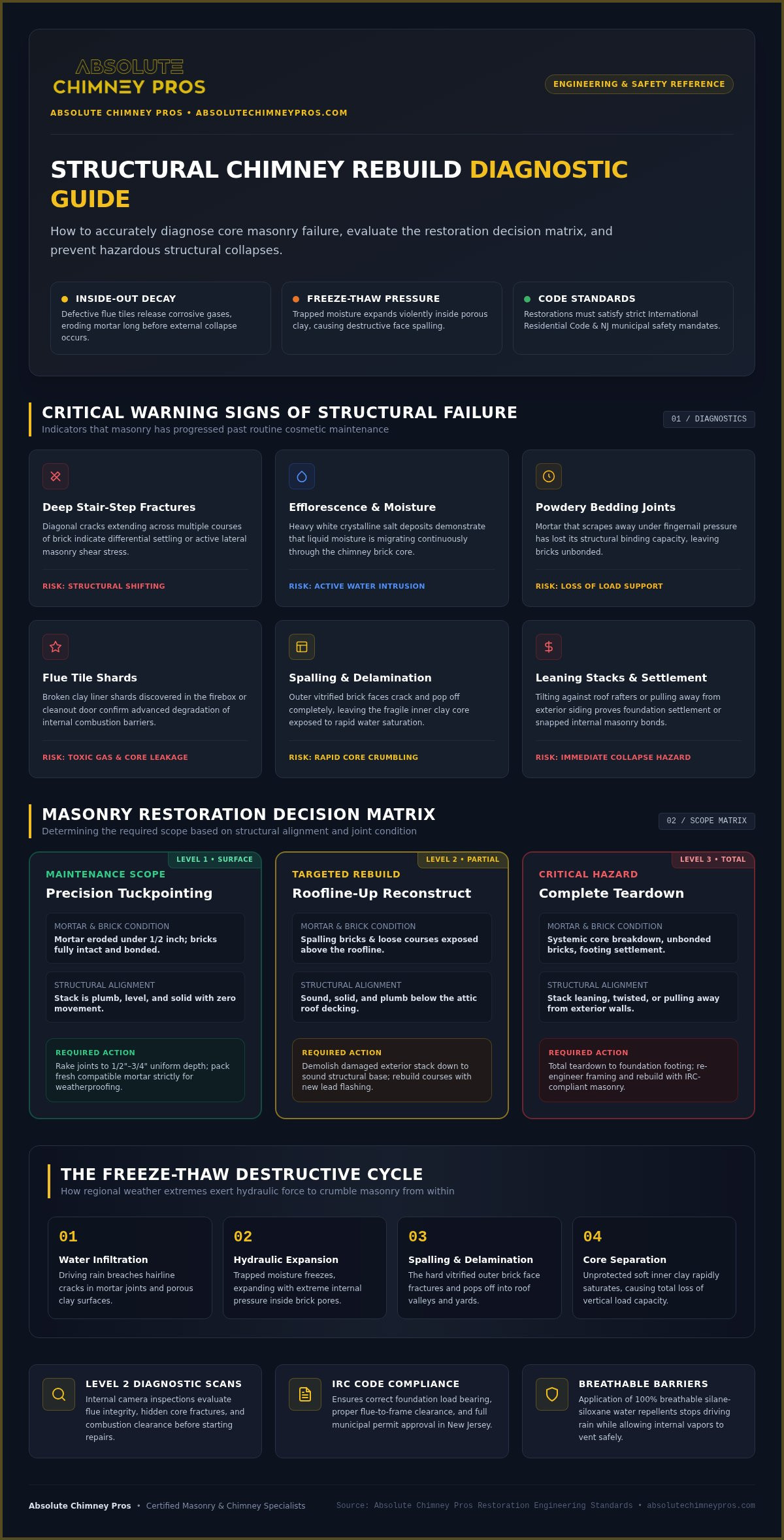
Masonry deterioration happens from the inside out. Long before a stack collapses, hidden stress fractures compromise the structure. Traditional masonry chimney construction relies on cohesive bonding between clay bricks and mortar to bear heavy vertical loads. When water breaches that barrier, structural strength plummets. Defective flue tiles leak corrosive combustion gases into the surrounding brickwork, eroding the mortar core silently. Identifying structural failure early prevents catastrophic roof cave-ins and costly interior water damage.
Watch for these distinct warning signs that indicate advanced structural compromise:
- Deep stair-step fractures: Diagonal cracks running across multiple courses of brick indicate differential settling or lateral masonry shear.
- Efflorescence and dampness: Heavy white salt deposits show that water is migrating continuously through the chimney core.
- Soft, powdery bedding joints: Mortar that scrapes away with a fingernail has lost its structural binding capacity.
- Flue tile fragments: Shards of clay discovered in the fireplace firebox or cleanout door signal severe internal liner failure.
Recognizing Severe Spalling and Masonry Delamination
Spalling occurs when moisture freezes within porous clay, forcing the outer brick faces to crack, flake, and pop off entirely. This is not cosmetic wear. Once the protective outer vitrified face breaks away, the soft inner clay core absorbs driving rain rapidly. Debris gathering along roof valleys or dropping onto your yard signals advanced delamination. Hollow, crumbling walls cannot bear their own weight safely, making a partial or complete chimney rebuild NJ homeowners can rely on an immediate safety necessity.
Leaning Stacks and Foundation Settlement Hazards
A tilted chimney stack presents an immediate structural hazard. Chimneys must remain plumb to distribute vertical loads evenly down to the footing. If your stack tilts, leans against rafters, or pulls away from exterior home siding, the interior masonry bond has snapped or the concrete foundation footing has settled unevenly. Never ignore a shifting roofline. Scheduling a certified annual chimney inspection NJ allows trained technicians to measure structural displacement and verify whether stabilization or a complete chimney rebuild NJ codes mandate is required.
Tuckpointing vs. Partial vs. Complete Rebuild: The Decision Matrix
Selecting the wrong restoration level wastes money and leaves catastrophic hazards unaddressed. Homeowners often hope a quick cosmetic patch will resolve deep deterioration. Repointing over an unstable, hollow core creates a dangerous illusion of safety while the underlying structure continues to degrade. Accurate masonry diagnostics evaluate joint erosion depth, brick integrity, and vertical alignment against strict International Residential Code masonry chimney standards to determine the necessary scope of work.
| Mortar & Brick Condition | Structural Alignment | Required Action |
|---|---|---|
| Mortar eroded under 1/2 inch; bricks intact | Stack is plumb, level, and solid | Precision Repointing / Tuckpointing |
| Spalling bricks and loose courses above roofline | Sound and plumb below the attic decking | Partial Rebuild (Roofline Up) |
| Systemic core breakdown, broken bonds, settlement | Stack leaning, twisted, or pulling from wall | Complete Chimney Teardown & Rebuild |
When Tuckpointing and Repointing Are Sufficient
Repointing removes degraded mortar to a uniform depth between one-half and three-quarters of an inch before packing fresh, compatible mortar into the joints. This procedure is strictly restorative for weatherproofing. It only works if the individual bricks remain structurally intact and firmly bonded. If you can wiggle a brick with your bare hand, the structural core has separated. Repointing over shifting masonry is unsafe and violates basic construction logic.
Partial Rebuild (Roofline Up) vs. Complete Teardown
Exterior weather exposure punishes the stack above the roofline. When freeze cycles destroy the upper courses while the masonry inside the attic remains sound, a partial chimney rebuild NJ specialists perform eliminates the compromised section down to solid brickwork. If shifting occurs at the firebox level, foundation footings settle, or cracks run down the entire chase, a complete ground-up teardown is unavoidable. Diagnostic protocols detailed in our chimney leak repair NJ guide help pinpoint where structural failure stops. You can consult with Absolute Chimney Pros to secure an accurate, transparent structural evaluation before planning your project.
Why New Jersey Freeze-Thaw Cycles Accelerate Chimney Failure
New Jersey's winter climate creates brutal conditions for exterior masonry. The state experiences an average of 55 to 75 freeze-thaw cycles every single winter, with northern counties regularly exceeding 80 cycles. Daytime temperatures hover between 38°F and 45°F, allowing melted snow and freezing rain to soak deep into exposed chimney stacks. When night falls, temperatures drop well below 28°F. Trapped water expands by roughly 9% upon freezing, generating destructive internal hydraulic forces up to 30,000 PSI inside porous clay and aged lime mortar. These thermodynamic pressures exceed the natural tensile strength of brickwork, triggering progressive structural collapse that eventually makes a comprehensive chimney rebuild NJ properties need unavoidable.
Evaluating this structural fatigue requires disciplined diagnostics under established NFPA 211 inspection guidelines. When internal fracturing spreads across bedding joints, surface repairs can no longer secure the stack against sudden failure.
The Mechanics of Winter Moisture Trapping in Porous Masonry
Clay bricks function like dense sponges when their vitrified surface finishes erode. Unsealed masonry absorbs driving rain and melting ice throughout the afternoon. As temperatures plummet past the freezing mark, the trapped moisture crystallizes and expands rapidly within the microscopic pore network. Freeze-thaw spalling is the progressive structural delamination of masonry caused by repetitive internal ice expansion. This cycle fractures the brick body from within, turning solid structural masonry into crumbly, hollow shells unable to support flue weight.
Coastal Air, Humidity, and Severe Nor’easters Across NJ
Coastal communities face intensified masonry degradation. Shoreline properties across Monmouth, Ocean, and Atlantic counties endure relentless maritime winds and frequent, heavy Nor'easters that blast horizontal moisture against chimney faces. Airborne sea salt deposits enter damp joints, crystallizing inside mortar beds and accelerating chemical breakdown. Standard film-forming exterior paints trap this salty moisture inside the brick core, worsening spalling behind the surface. Long-term exterior protection requires breathable, vapor-permeable silane or siloxane water repellents that block wind-driven ocean rain while allowing internal household moisture vapor to vent harmlessly into the open air.
The Step-by-Step Engineering Process of a Professional Chimney Rebuild
Structural chimney restoration is disciplined engineering, not casual handiwork. Every phase demands strict adherence to the New Jersey Uniform Construction Code to guarantee long-term stability and fire safety. Flue alignment must remain continuous to prevent hazardous carbon monoxide bypass into living spaces. Executing an enduring chimney rebuild NJ building officials will approve requires an orderly, multi-step construction protocol.
Site Staging, Roof Protection, and Controlled Demolition
Crews first erect pipe scaffolding and lay heavy-duty reinforced tarps across the roofline. This safeguards structural decking and architectural shingles from accidental impact. If falling masonry or persistent leaks have already compromised the surrounding roof deck, discover United Roofing & More! to learn about professional residential and commercial roof replacement standards. Masons dismantle compromised brickwork using hand tools and lightweight rotary hammers rather than heavy sledges. Controlled hand demolition prevents concussive shockwaves from cracking interior plaster or loosening lower masonry joints. All broken brick, mortar slurry, and cracked flue tiles are systematically cleared in compliance with local municipal disposal ordinances.
Masonry Reconstruction, Flue Integration, and Crown Pouring
Rebuilding starts directly from sound, level masonry. Craftsmen lay high-density modular clay bricks using ASTM C270 Type N mortar to accommodate regional temperature shifts without cracking. If upgrading the flue with a stainless steel liner, technicians wrap the conduit in high-temperature ceramic insulation to maintain proper clearances from adjacent framing. At the top of the stack, masons pour a steel-reinforced concrete crown. Unlike thin mortar washes that crack quickly, an engineered crown features a two-inch perimeter overhang with an integrated drip edge underneath to divert rainwater away from the brick face.
Counter-Flashing Installation and Hydrophobic Sealing
Roof transitions demand durable, mechanical waterproofing. Technicians embed custom-bent metal step and counter-flashing directly into freshly cut mortar joints around the chimney base. Slapping roofing tar or silicone caulk across open seams is an invitation to leaks; sealants dry out, shrink, and fail within two seasons. Finally, once new mortar cures fully, technicians apply a breathable, siloxane-based penetrating water repellent across all exterior courses. This stops wind-driven moisture while allowing internal heating vapors to escape harmlessly.
Need structural restoration completed by trained specialists? Contact Absolute Chimney Pros for a comprehensive structural assessment and secure code-compliant masonry execution for your home.
Protecting Your Restored Chimney: Inspections, Codes, and Preventative Care
A structural rebuild restores your home's thermal boundary and masonry defense. Protecting that investment requires ongoing vigilance and certified maintenance. Skipping routine care leaves new brickwork open to premature weathering, while hiring uncertified labor can lead to code violations, failed municipal inspections, and denied insurance claims. Preserving your structural investment demands rigorous verification and proactive upkeep.
Why CSIA Certification and New Jersey Building Permits Matter
New Jersey law treats structural chimney work seriously. Under the New Jersey Uniform Construction Code (N.J.A.C. 5:23), partial and complete reconstructions require official municipal building permits. Local subcode officials inspect footings, clearances, and flue dimensions before signing off. Work performed by uncertified handymen without permits can compromise real estate transactions under state property disclosure laws. CSIA-certified sweeps adhere to stringent national safety protocols, ensuring every chimney rebuild NJ townships inspect passes code the first time. Verifying that your contractor carries an active New Jersey Home Improvement Contractor registration and adequate liability insurance guarantees complete accountability.
Essential Long-Term Defense: Heavy-Duty Caps and Regular Sweeping
Water remains the primary enemy of exterior masonry. Installing a heavy-duty, 100% stainless steel or copper chimney cap provides essential defense at the top of the stack. A properly sized cap shields the flue opening against driving rain, stops downdrafts, and features an integrated spark arrestor that prevents animal nesting. Pair this protective hardware with scheduled maintenance; booking a routine chimney sweep NJ appointment removes corrosive acidic deposits that eat away at interior flue walls over time.
Homeowners should maintain a basic seasonal inspection checklist:
- Spring flashings review: Check roofline metal joints for physical displacement or lifting edges after winter storms.
- Terminal cap anchoring: Ensure top-mounted caps remain tightly bolted and free of rust or bird debris.
- Crown surface inspection: Look for hairline surface cracks on the top slab before water can penetrate the core.
- Internal draft checks: Confirm flues exhaust smoothly without sending backdraft odors or smoke into living quarters.
Executing an engineered chimney rebuild NJ building codes enforce eliminates structural hazards. Following up with disciplined annual certified sweeps ensures your restored masonry stack protects your household for decades to come.
Secure Your Masonry and Protect Your Home Today
Ignoring crumbling brickwork or a shifting stack creates an unacceptable hazard for your household. A compromised chimney core cannot withstand the elements, and cosmetic patches only mask deeper structural distress. Whether your property requires a targeted roofline restoration or a full teardown, executing a code-compliant chimney rebuild NJ building officials will certify preserves both property value and family safety.
You don't have to navigate structural decisions alone. Absolute Chimney Pros acts as your disciplined partner in home defense. Our CSIA-certified technicians provide transparent on-site structural diagnostics, delivering clear written documentation with no hidden fees or rushed assessments. As a fully licensed and insured New Jersey residential masonry specialist, we eliminate guesswork and ensure your chimney stands firm against the harshest coastal storms. Take the decisive step to safeguard your home. Schedule your precision chimney inspection with Absolute Chimney Pros to restore structural stability and enjoy true peace of mind today.
Frequently Asked Questions
How do I know if my New Jersey chimney needs a partial or complete rebuild?
Structural damage location determines the required scope of work. A partial rebuild is sufficient if masonry deterioration is confined strictly above the roofline while attic masonry remains plumb and structurally solid. A complete teardown is mandatory if the stack leans, exhibits stair-step fractures below the roofline, or suffers foundation settlement. A certified diagnostic inspection accurately maps internal flue integrity to determine the exact boundary where structural compromise stops.
Can cold New Jersey winter weather damage fresh chimney mortar during a rebuild?
Freezing temperatures destroy wet mortar if ambient conditions drop below 40°F before the mix cures. Ice crystals fracture uncured Portland cement and lime bonds, leaving joints weak and chalky. Professional masonry teams utilize heated water, weather-shielding tent enclosures, and specialized cold-weather handling when executing a late-season chimney rebuild NJ winter conditions threaten. Staging thermal barriers ensures joints reach optimal compressive strength regardless of ambient temperatures.
Is a building permit required to rebuild a residential chimney in New Jersey?
Municipal construction offices across New Jersey require permits for partial and complete chimney reconstructions under N.J.A.C. 5:23. Structural alterations directly impact fire separations, roof flashing penetrations, and combustion draft safety. Licensed contractors pull these permits and coordinate required rough-in and final building inspections. Skipping official permits creates serious liability during future property disclosures and can void homeowner insurance coverage after a fire event.
What happens if I ignore crumbling chimney mortar and spalling bricks?
Deferred maintenance allows rainwater to penetrate the chimney core continuously. Weakened masonry eventually shears, sending loose bricks crashing onto your roof shingles or yard below. Internally, deteriorating masonry allows toxic flue gases, including odorless carbon monoxide, to seep through cracked walls into living areas. What starts as damaged surface mortar inevitably escalates into an emergency structural hazard threatening the entire home envelope.
Can I install a new flue liner during a masonry chimney rebuild?
Rebuilding the stack exposes the interior flue channel, making it the ideal time for chimney liner installation. Installing an insulated, UL-listed stainless steel liner protects new brickwork from corrosive combustion gases and acidic exhaust condensation produced by modern heating appliances. Upgrading the liner during a structural chimney rebuild NJ homeowners undertake establishes an enduring fire barrier and guarantees proper draft performance for the entire system.
Why did my previous chimney repair fail after only a few years?
Widespread repair failures occur when handymen tuckpoint over shifting bricks or apply non-breathable sealants that trap moisture inside. Trapped water accelerates brick delamination during regional freeze cycles. Using overly hard mortar mixes also cracks older, softer clay bricks under thermal stress. Lasting restoration requires matching mortar composition, rebuilding damaged structural courses down to stable masonry, and ensuring water sheds properly away from the roofline.
How does a professional chimney crown differ from a simple mortar wash?
A mortar wash is merely a thin, beveled layer of standard mortar spread across top bricks that rapidly shrinks and cracks. An engineered crown is a dedicated cast-in-place concrete slab reinforced with steel mesh. It extends past the chimney frame with a two-inch overhang and an integrated underside drip edge. This structural overhang forces runoff to fall harmlessly away from vertical masonry joints below.


